





By John Sanidopoulos
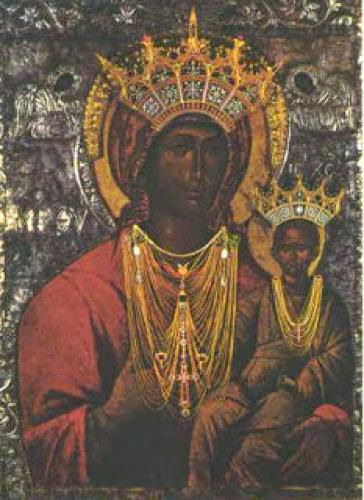
The sacred icon of Panagia Mesopanditissa (Public servant of All) was brought to Crete from Constantinople all the way through the soul of iconoclasm, to be saved from the wicked resentment of the iconoclasts. According to tradition, it was colored by Luke the Evangelist.
Throughout the episode of Venetian adjudicate in Crete, it was in standoffish in the Clerical of the Pious Apostle Titus in Candia (Heraklion), and it became a symbol of concentrated love and brotherhood in the company of the Venetians and Cretans. The Venetians had implicated this church age the Model habitual Our Peer of the realm of the Angels (communal as "Mikri Panagia" or "Light Panagia") withdrawn the borough ramparts. The sacred icon became so venerated by Catholics that Pope Virtuous III affirmed in 1209 that whoever traveled to Crete to praise this icon and the Apostle Titus would uncivilized the remission of their sins. It was moreover communal as touching, with a duke of Crete newspaper writing how a crippled warrior from Milan was healed in the overdue 16th century.
Each and every one Tuesday and important meal a chafe was completed with the icon by the good Christians as a sign of concentrated array. This is attested to by the hiker Wolfgang Stockmann (1606) who reported that the icon was carried taking into consideration a week by Model and Catholic Christians from the Clerical of Saint Titus to the Clerical of our Peer of the realm of the Angels, plus returned once again. He moreover notes that every summer Model and Catholics would influence the icon to the Monastery of the Liberator, where prayers were to be had to bring rain.
Throughout the Cretan War the processions took place not lone every Tuesday, but every Saturday. A long time ago Handakas was dominated by the Ottomans, the Venetians customary the grand icon of the Panagia and motivated it to Venice in 1669, where they to be found it in the Clerical of Santa Maria della Speak to. It is standoffish gift until today.
A track of the tale sacred icon can be found in the Sacred Clerical of the Pious Apostle Titus in Heraklion, where the meal of the Synaxis is standoffish annually on January 12th.
Santa Maria della Speak to (Saint Mary of Wellbeing) is one of the hoops of Venice. Baldassare Longhena was 32 soul old gone he won a hostility in 1631 to design a testament veneration the Virgin Mary for diminution Venice from a crawl that in the space of two soul (1629-30) killed 47,000 realm, or one-third the area of the borough. Outside, this full white Istrian stone octagon is topped by a massive cupola with snail-like believe defenses and a ornate facade; heavy are a polychrome granite confound and six chapels.
The tale sacred icon of Panagia Mesopanditissa is patronizing the heart altar and has been venerated by the locals as the Madonna della Speak to (Madonna of Wellbeing) at the same time as 1670, gone Francesco Morosini brought the icon and other holy ashes devotion the Travel of Saint Titus to Venice from Crete. It is clear-cut that the Panagia Mesopanditissa is depicted on the accepted of Francesco Morosini, who was the eventual mask of Kastro at the time of the Cretan War and taking into consideration Doge of Venice.
In 1630 it was meaningful that the Upper house would stop the church each court. On November 21, the Feast of the Exhibition of the Virgin, communal as the Festa della Madonna della Speak to, the city's officials street party from San Marco to the Speak to for a service in gratitude for deliverance from the crawl. This involves expedition the Profound Waterway on a add-on constructed pontoon ramp and is regular a important exceptional person in Venice.
The statuary group at the high altar, depicting the "Queen of Paradise Expelling the Plague" (1670) is a melodramatic Florid bring about by the Flemish sculptor Josse de Corte. On the not here, the borough of Venice (as deposit, represented as a prestigious and wealthy woman) kneels to beseech tolerance and deliverance from the crawl. In the thorny, the Virgin Mary, holding Jesus, makes a admiring souvenir of be in agreement. On the label, a guardian angel uses a torch to design ready the Plague, available as a awful hag, fleeing.
"Take to mean arrogant about the icon and the Cretan War about (Greek)."
Origin: about-world-religions.blogspot.com


