Wicca is a modern pagan, witchcraft religion

Wicca is a diverse religion with no central authority or figure defining it.

Wicca often involves the ritual practice of magic, though it is not always necessary

Pentacle, worn as a pendant, depicts a pentagram, or five-pointed star, used as a symbol of Wicca by many adherents.

Beliefs in Wicca range from hard polytheism to even monotheism.

Wicca is typically duotheistic, worshipping a god and goddess traditionally viewed as a mother goddess and horned god.

The term Wicca first achieved widespread acceptance when referring to the religion in the 1960s and 70s

Application of the word Wicca has given rise to "a great deal of disagreement and infighting".

The Goddess and the God may be regarded as the Divine Feminine and the Divine Masculine

The God and Goddess are generally seen as lovers and equals, the Divine Couple who together co-create the cosmos.

Traditionally the God is viewed as a Horned God, associated with nature, wilderness, sexuality, hunting and the life cycle

The Horned God is given various names according to the tradition, and these include Cernunnos, Pan, Atho and Karnayna.

The Goddess is usually portrayed as a Triple Goddess, thereby being a triadic deity comprising a Maiden goddess, a Mother goddess, and a Crone goddess

Some Wiccans, particularly from the 1970s onwards, have viewed the Goddess as the more important of the two deities, who is pre-eminent in that she contains and conceives all. In this respect, the God is viewed as the spark of life and inspiration within her, simultaneously her lover and her child.

Showing posts with label christianity. Show all posts

Saturday, March 28, 2015

History Mystery Did A Historical Jesus Exist Part I

History Mystery Did A Historical Jesus Exist Part I
Today all most every one of us in the world believes that Jesus Christ was a real personality. Perhaps he may not be the son of god or perhaps he may not be the real Messiah. The belief, Jesus as a human being came out as Eucharist ritual and theology concept of flesh and blood. Then what is the basis for the claim that "Jesus ever existed"?

There are two views we are going to analyze here. The first one is the Biblical or the religious view that Jesus as a real personality and the other one; The materialistic or the historical view. Here I wish to point out one thing. We have only one source of information about him which is the bible alone; that too more particularly from the Gospels. Everything we know about him is derived from the Gospels alone.

According to the Gospels, Jesus Christ was most popular and well-known personality who done splendid miracles and have the capacity of his own to pull the crowd. He not only done miracles but some revolutionary changes in religious system in the Jewish priesthood hence arrested and put to death before thousands of his followers who stood as eye witness. The historical view removes some exaggerated accounts in the life of Jesus in the Gospels taking into account.

Both of the views purely depend on the Gospels alone but, Are the Gospels give a reliable historical account? When the Gospels were written, where the gospels were written? which is the origin? Nobody knows. Earlier estimates dates the Gospels were written from 50 to 150CE and some ascertain that may be 4th Century. The traditional belief is that the Gospels had been written by the disciples of Jesus or someone who directly connected with them. It is believed that the Gospels are the eyewitness.

Let us gain some knowledge about the Gospels and its writers through the account of early church leader Papias of 130CE. According to him the Gospel Mark was not written by him but it was someone named Mark and the Gospel of Mathew was recorded by someone named Mathew in Hebrew dialect and so on... Since the Gospel of Mathew contains the virgin birth of Jesus and the hereditary lineage with David, the early theologians thought it was the first Gospel. Since the Gospel of Luke was not an eyewitness in nature and it was a self described one. So there is no possibility for it being first one.

The Gospel of Mark is also considered as second hand information since the order of events was different in order. The source of information for Mark is Peter. There is a chance that Mark might come from Rome where Peter preached. Theologian ascertains The Gospel of Mark was the first Gospel. Since Peter was shown as a fool who could not understand the messages of Jesus, Peter could not be the source of information for Gospel of Mark hence Mark is the first gospel. (Cont....)

Sunday, February 1, 2015

Healing Oil

Healing Oil
Psychoanalysis OIL Psychoanalysis Oil, Triple Last1/2 Up in the air Little Pane Be able to ~ 49.95Psychoanalysis Oil brings about gentleness, protection, and healing on all levels. Use for physical maladies, affecting troubles, spiritual crises, financial suspicions, and all other issues you possibly will come into contact with. * Fund gentleness and confusion to yourself, cherished one, and your home * Distinguish a enhance, expand flatten life with tabloid anointing * Stops ills and negative energy from dressed in and bringing you downHOW TO USE Run through OILS!Strap up OILS - Strap up is the act of using an oil on an item to add the be against or power of the oil. Extensive items that are honorable would be candles that are to be burned in a ritual, the tools hand-me-down in spell casting or ritual work such as chalices, athames, and other tools, and even the altar itself. Sundry faithful use of oils in bind up would be certain totems that are carried by a beast such as mojo belongings or hands, amulets, talismans, rings, and charms. Numberless sprint as a consequence dress corners of the home, data and entrance doors, and systematically items that belong to discrete beast, in addition the held of the magick ritual.ANOINTING OILS - Anointing with oils is the act of placing a trifling cutback of the oil on the dead body itself. The practice of anointing is in black and white about in the Bible, and is from one place to another absolutely not getting any younger. Oils call for be ended with ingredients that are not goodbye to put away harm to the bombard, but as somebody is distinct any oil hand-me-down call for be hardened in a very trifling flat to make sure you handhold no allergic reaction to it. Specific live in blend together anointing and bind up by anointing the clothes or shoes of the held or themselves. Anointing with oil is believed to add that power or energy to the wearer and they emboss this with them all day ache.FEEDING OILS - Passing through oils to stuff an understanding or totem is very uncommunicative to bind up, and more exactly systematically totems such as mojo belongings, amulets, and other spell cast charms are modest strong for their be against by adding together tabloid to their power with a bind up of oil. Specific accept a simple cutback or two masses, in addition on cloth belongings, but others having the status of to wipe down an amulet or ring with oil scientifically. Elaborate OILS - Elaborate Oil is discrete stipulation that overlaps in definition but is the outfit of using an oil in the act of casting a spell or performance a ritual. Supreme oils could be carefulness of as would like oils. Specific oils are expand systematically hand-me-down simply to dress a candle with one cutback spell other sprint possibly will surge a ring in an oil. Either way they can be believed to be would like oils hand-me-down in conjuring.Use your ritual oils creatively. Notify that Papa Laugh has worked to pledge these oils handhold the full effect of an inner self of the able-bodied ingredients along with herbs, minerals, extraction, and expand. All oils are seal in pane bottles for a ache life.The prepare line of Papa Laugh Run through Oils can be found fashionable.

Credit: masonsofheaven.blogspot.com


Friday, January 30, 2015

Prebyteries Dancing Like Puppets

Prebyteries Dancing Like Puppets
Sometimes reading is hazardous to a sense of reality. Trust can be broken in the midst of a hierarchy of words.

Several Pastors, within and without the PCUSA, recently blogged on the Advisory Committee on the Constitution's advise on the Presbytery of Charlotte's questions about the transfer of ministers and Congregations to Transitional Presbyteries.

The two questions were:


Can a presbytery dismiss a congregation to a transitional presbytery in the Evangelical Presbyterian Church?

Can a presbytery dismiss a minister of the Word and Sacrament to a transitional presbytery of the Evangelical Presbyterian Church?

One blogger who is an Evangelical Presbyterian Church Pastor is naturally interested. Pastor David Fischler of the The Reformed Pastor wrote Down the Rabbit Hole. And Presbyterian USA Pastor Toby Brown of Classical Presbyterian wrote, Ex Cathedra: The ACC of the PC(USA) takes aim at dismissals to the EPC. The first blog posting I read about the advisory was after returning home from a Presbytery meeting. It was written by Pastor Bob Davis at Presbyblog. He wrote, May 6, 2008: ACC recommends Authoritative Interpretation regarding transitional presbyteries.

Davis points out the advisory's recommendations to Presbyteries. He writes:

"The provisions of G-15.0203 a and b do, however, require that the General Assembly, as the highest governing body of this denomination, advise its presbyteries in this matter. The 218th General Assembly (2008) therefore advises the presbyteries that they must satisfy themselves concerning the conformity with this denomination of a transitional presbytery of the Evangelical Presbyterian Church (EPC) in matters of doctrines and order. Presbyteries may facilitate the exploration of conformity by means of an administrative commission, although such commissions may not be empowered to approve the dismissal of the congregation. In exploring this matter, presbyteries should consider such questions as whether the receiving EPC presbytery is

*


doctrinally consistent with the essentials of Reformed theology as understood by the presbytery;

*


governed by a polity that is consistent in form and structure with that of the Presbyterian Church (U.S.A);

*


of sufficient permanence to offer reasonable assurance that the congregation is not being dismissed to de facto independence.

Failure on the part of the presbytery thoroughly to explore and adequately to document its satisfaction in these matters may thus violate, however unintentionally, the spirit of the polity of the Presbyterian Church (U.S.A.). "

Davis also wrote, "This is a pure regulatory move. It is not missional in design. It would take away authority from the presbyteries and establish greater authority in the higher "governing" bodies. It would have a chilling effect on congregations trying to discern where God is calling -- heightening the sense of distrust."

I was surprised by Pastor Davis's posting. The reason I was surprised: I thought that the advisory must have been posted for several weeks on PC-BiZ and instead it was only posted on May the 6th the day of our Presbytery meeting.

I had already read the Advisory and saw how it had been used since it was a part of the papers posted on our presbytery's web site a week ago. And it was used in the first report written by a mediating team concerning a church in our presbytery seeking dismissal from the PCUSA. The first two meetings with the teams from both the church and the presbytery were held on April the 9th and 11th. So I have two questions concerning these papers.

* I wonder how many other mediating teams in other presbyteries are receiving this advice from Louisville or more succinctly the Office of the General Assembly before it is even voted on by General Assembly?
* I also wonder if other mediating teams are giving out the suggestion this team did in its first report? That is, given the advisory recommendation to the Presbyteries, "We noted that these issues were the subject of a Request for interpretation from the Presbytery of Charlotte that is currently pending before the General Assembly for consideration at the June meeting, and Presbytery [Sacramento] might choose to defer making a determination with respect to those issues until the General Assembly acted on that Request."

In other words, the suggestion was being given that our Presbytery might just want to put this off until after General Assembly. As it happened mediation broke down without this ploy being used. I am not blaming our Presbytery, I am not blaming the mediating team. I am just saying it seems like Presbyteries are becoming puppets on a string being pulled by others in Louisville. That isn't connectionalism, its madness because it will simply further erode any small bit of trust left in the Church.

"(It should be noted that this church asked to be dismissed to the EPC not to a transitional presbytery.)"

Tuesday, January 13, 2015

The Old Rite Put In Its Place

The Old Rite Put In Its Place
So runs the title of this week's editorial of The Tablet.The editorial is a reflection on a foreword, written by Archbishop Nichols, to a booklet that will be given to priests taking part in the 24-28 August conference at All Saints Pastoral Centre, London Colney. I do not have the article to hand but can comment on the Tablet's editorial without bringing in personal likes and dislikes, but simply applying the Church's law.The editor begins:One of Pope Benedict XVI's most controversial initiatives has been his promotion of the Tridentine Rite of Mass as an alternative to the revised rite that reflects the reforms of the Second Vatican Council.Many things that the Church and her pastors direct are controversial simply by being controverted such as the teaching on artificial birth control contained in Pope Paul VI's encyclicalHumanae Vitae and Vatican II's Gaudium et spes. The fact of being controverted does not, however, make them any less legitimate.The Tablet continues:His message is unambiguous, and may not please some of those hoping to attend the conference. First, he has insisted that the training conference is officially sponsored by the Diocese of Westminster, "in conjunction with the Latin Mass Society", thereby keeping it under his control. In church teaching and canon law, he states, bishops are responsible for the oversight of the liturgy. Many feel a bishop's role in these matters has been undermined by Pope Benedict's motu proprio "Summorum Pontificum", which appears to allow priests to opt for the Tridentine Rite regardless of the attitude of local bishops.Of course, the bishop is the moderator of the liturgy in his diocese, but always in accordance with the universal law of the Church. Whatever people feel, the fact is that Summorum Pontificum does indeed allow priests to celebrate the extraordinary form (which The Tablet insists on calling "the Tridentine Rite") without the permission of the bishop:Art. 2: In Masses celebrated without the people, each Catholic priest of the Latin rite, whether secular or regular, may use the Roman Missal published by Bl. Pope John XXIII in 1962, or the Roman Missal promulgated by Pope Paul VI in 1970, and may do so on any day with the exception of the Easter Triduum. For such celebrations, with either one Missal or the other, the priest has no need for permission from the Apostolic See or from his Ordinary.The Tablet:Archbishop Nichols gives no shred of encouragement to those who want the Tridentine Rite to replace the newer version. Conference participants "will wholeheartedly celebrate the Mass in each of these forms", he instructs them bluntly, adding: "The view that the ordinary form of the Mass, in itself, is in some way deficient finds no place here." People who hold that view are "inexorably distancing themselves from the Church", he says. There is no scope, in other words, for "Tridentine Rite" parishes that set themselves up in the spirit of being "more Catholic than thou".Well, I hope it works both ways, that those who refuse to accept the extraordinary form do not consider themselves more catholic than those who prefer the extraordinary form. I would hope that The Tablet, which prides itself on dissent from - or at least controverting upon - much of the Church's official teachings will allow thinking catholics the space to discuss the relative merits of one form of the Mass over the other. After all, the whole point of the provisions of Pope John Paul II's Motu proprio Ecclesia Dei and Pope Benedict's Summorum Pontificum was to respond to the legitimate aspirations of those who remained attached to the older usage. In the former document, Pope John Paul had already written:(M)oreover, respect must everywhere be shown for the feelings of all those who are attached to the Latin liturgical tradition, by a wide and generous application of the directives already issued some time ago by the Apostolic See for the use of the Roman Missal according to the typical edition of 1962.Furthermore, Summorum Pontificum allows for the erection of personal parishes and chaplaincies exclusively dedicated to the provision of the extraordinary form:The ordinary of a particular place, if he feels it appropriate, may erect a personal parish in accordance with can. 518 for celebrations following the ancient form of the Roman rite, or appoint a chaplain, while observing all the norms of law.My experience of the conference in Merton last year was that most, if not all, of the priests attending were regular parish priests whose daily celebration of the Mass was and would remain in the ordinary form. They would continue to celebrate it "wholeheartedly" even if with the benefit of the "mutual enrichment" envisioned by Pope Benedict in Summorum Pontificum. Also, attendees were provided with the opportunity to celebrate Mass daily in the ordinary or extraordinary form according to their preference, or indeed to concelebrate (in the ordinary form, naturally). So, in fact, both forms of the Mass were being celebrated and the form one celebrated in was not, in my experience, a cause of division or being thought of by the others as being more or less catholic.The Tablet:Recognising the threat of such moves, Archbishop Nichols is seeking to nip a potential schism in the bud.Schism is a very technical word and The Tablet does its readers a great disservice in using it so imprecisely, just as it uses the term "Tridentine Rite" instead of "extraordinary form". There is no potential schism. All those attending the conference are faithful catholic priests.His firm leadership in Westminster is one that other bishops in England and Wales - and elsewhere - will welcome. The Catholic Church does not need its own version of "culture wars", and in his message the archbishop in effect declares a priest's personal tastes or preferences to be irrelevant.There would be no "wars" if all accepted peaceably the directives of the Holy Father in these matters. The priest now has a right to celebrate the extraordinary form privately whenever he wishes. Any decision to do so is bound to made on the basis of his preferences. The Tablet wants to deny priests their right in this matter.The Tablet:Furthermore the distinctive feature of the Tridentine Rite, and the single most pressing reason why the bishops at Vatican II wanted it reformed, was the absence of any role for the laity. They were little more than spectators of what the celebrant was doing at the altar; in practice this meant many of them concentrated on their own private devotions.We have here a very distorted understanding by The Tablet of active participation. The faithful for whom I celebrate the extraordinary form consider themselves to be very much involved, being drawn into the mysteries they celebrate and praying in union with the priest at the altar. They should not be bullied into making responses, shaking hands etc. if they do not wish to.Archbishop Nichols insists it is an "established principle of good liturgy" to encourage the active participation of all those taking part in the Mass, a principle needing "careful consideration and application by every celebrant".This can be done by instructing the faithful - priests and laity - on the true nature of the Mass so that they have a greater understanding of what is being celebrated and accomplished. In my celebrations of the extraordinary form, I have indeed exercised very "careful consideration and application" so that I may celebrate the Mass with faithfulness to the rubrics and tradition so that the people do not get Father John's Mass but the Mass of the Church.The Tablet now goes on to make a giant deductive leap:Implicit in this directive is the rejection of any discrimination against girls and women among those who assist at Mass, such as altar servers, readers and extraordinary ministers of the Eucharist. That some Tridentinist priests have banished females from the sanctuary or lectern in the name of authenticity has more than a whiff of misogyny.How can The Tablet deduce this conclusion from the Archbishop's words? The Tablet fails to remind its readers that Vatican II directed that the stable ministries of acolytate and lectorate be restored but that the Bishops have not restored these ministries. Why? Because they are reserved to men. So there is a selective application of the directives of the Council. The council and, indeed, the Code of Canon Law, states that other lay faithful - of either sex - may, in the absence of instituted ministers, exercise these roles. But their role is supplementary, not essential. As for extraordinary ministers of the Eucharist, these are not necessary in any Mass. They are permitted if, in the opinion of the parish priest, the distribution of Communion would take too long, but they are not required. And in the extraordinary form, Communion is only given under one kind (although that could be reformed).What is a "Tridentinist" priest anyway? Thus has Archbishop Nichols neatly answered virtually every objection to the motu proprio,...Was that the Archbishop's intention, to "neatly answer virtually every objection to the motu proprio"? Or to give practical guidelines for its implementation.... and the Tridentine Rite can henceforth take its proper - and necessarily marginal - place in the life of the Catholic Church.Let the people - not The Tablet - decide whether the extraordinary form (again styled "Tridentine Rite" by The Tablet") will be marginal, as Pope Benedict has given them the right to.Indeed, he has made it accessible to those who are fully committed to Vatican II. Just as the ordinary form Mass is accessible to those who are fully committed to Vatican II, including its teaching on artificial birth control (Gaudium et spes) and other issues one could raise such as the infallibility of the Pope and the need for religious submission of intellect and will to the ordinary magisterium of the Church.This timely display of clear leadership from the new president of the Catholic Bishops' Conference of England and Wales bodes well.I'm sure it does.

Thursday, November 6, 2014

Isnt It True That Christians Must Obey The Kosher Food Laws This Is What Acts 10 And 15 Teaches

Isnt It True That Christians Must Obey The Kosher Food Laws This Is What Acts 10 And 15 Teaches
Question: [editor's note: this lengthy question and points being made come from a Jewish Christian who believes that Christians are required to obey kosher food laws, such as the prohibition of eating pork and shellfish. The article he and I both refer to is one about the interpretation of Acts 10. I am attaching this here: A Hebraic Perspective on Peter (3) ]

I am by no means a scholar. But then Jesus did not pick from the educated in regard to the first Disciples. He picked the common laborer like me. Given the above, I will do my best to answer your questions; however, I would encourage you to return to the document I provide and do a thorough reading instead of a quick read. My experience with people who do a quick read is that they miss the main qualifiers (no disrespect to you intended). Personally, I find the conclusion solid. Take the two different Greek words for unclean and apply them to the other controversial Scriptures and tell me if the proposition holds or not. Mark 7:19: If the parenthetical statement was actually made by Jesus, then why doesn't Matthew, who clearly presents a more thorough witness, note it in his testimony about the same incident reported in Matthew 15:1-20? In Matthew, the key complementary verses would be 15:17-18.

I would suggest the following: Jesus himself, being God, gave the kosher commandments at Sinai. Never ever was pork, crab, shrimp or other items specifically mentioned starting in Leviticus 11 intended for food. It is only man, in his rebellion against God, who took it upon himself to "decide" that pork and other unclean animals were now clean and suitable for food. Didn't Jesus himself say that he did not come to abolish the Law? And, then he went on to declare the consequences, both good and bad, for those who did change the Law given at Sinai (Matthew 5:19). Matthew 15:1-20 and Mark 14:7 are dealing with hand washing not food. Starting at verse one it is very clear what the topic of discussion is: Rabbinical Oral Law in regard to ceremonial hand washing. Hand washing before eating, to the best of my knowledge, is something that God never prescribed. Jesus, in Matthew 15:3-9, immediatly takes them to task about their own traditions instead of holding to Gods commandments. In verses 10-11, Jesus calls to the people and tells them that it is not what enters into the mouth (food by unwashed hands) that defiles the man, but what proceeds out of the mouth. This is the start of the hangup for most people who argue that Jesus did away with kosher. Jesus held to the Law because he gave the Law, and he would have never suggested that unclean meat would have been part of "what enters into a man." Pork, crab, shrimp, and other unclean items were never intended to enter into a man and were not considered food by Jesus or anyone who held to the Law given by God. Then, Jesus went on to explain that the things out of the heart are those that defile the man, not unclean hands.

Jesus himself defines what the argument and topic at hand was in verse 20: These are the things which defile the man; but to eat with unwashed hands does not defile the man(Emphasis added). People for centuries have automatically assumed that the above mentioned unclean food items are what was in questions. There is no proof from Scripture that that would be the case. Someone who translated Mark added the parenthetical statement without grounds. I know this is simplistic, but I told you I am not a scholar.

Response:

I looked at your friend's interpretation of Acts 10 and I find it very credible. I would not say that it is definitely correct. To be honest, I think it could go either way, but his interpretation definitely makes sense-that God is telling Peter that he can join together in fellowship with a Gentile.

Also, I agree with you that in Matthew 15:1-20 and Mark 14:7, Jesus is talking, not about obeying the kosher laws, but about obeying the additions to the Law which were created by the Pharisees. This passage does not deal with food laws either way. Jesus is not saying here whether Christians ought or ought not to eat non-kosher foods. We know that Jesus obeyed the Mosaic Law while he was on the earth. This fact neither proves nor disproves whether a Christian can eat non-kosher foods, however.

Having said that, I do not agree with your overall conclusion. I believe that what you are doing is known as eisegesis, which means reading an interpretation into the Bible rather than getting it out of the Bible. Here is what we can be sure of as fact: the very early church interpreted the sayings of Jesus and the apostles as allowing the eating of foods which would be "unclean" to the Jews. The reason we know this is that it is a historical fact that the early church ate non-kosher foods. I am talking about the early second century.

About Mark 7, you say that Matthew is always a more complete story and that, therefore, we can simply ignore what Mark said. I am definitely not going to go there. I believe that the entire Bible is inspired by God. Mark quite often has a version with more details than Matthew. Will we simply throw out all the material in Mark which is not also in Matthew? Why not just throw out all of Mark if we only accept things in Mark that are also in Matthew. This is not an acceptable approach to the Bible. You said that the aside in Mark that Jesus declare all foods clean is not in the earliest manuscripts. This simply is NOT TRUE. I have looked around and the evidence does not support this conclusion. I think that this is wishful thinking on your part.

Another point. If Jesus said that Christians are not required to obey the restrictions of the Jewish/Mosaic Law, this does NOT nullify Leviticus 17 and 18. Jesus said that he would not take away a single word of the Law. Instead, he fulfilled the Law. Obviously, Jesus did not eat unclean food, as he was a Jew, but the question is whether Christians who are not Jews have to obey the Law in Leviticus. Are Christians required to obey the Sabbath? The answer, clearly, is no. Does that mean that Jesus nullified the Sabbath teaching in Leviticus? No. He fulfilled it. Do Christians have to obey the command about skin diseases, about Jubilee years, about daily sacrifices? Are Christians allowed to divorce their wives? Your argument simply does not hold up. The very purpose of the book of Galatians is to tell Christians that they are not bound by the Mosaic Law and that people who say they are have denied the faith. They are to be "eternally condemned." This is strong language. Colossians 2:16 says, "Do not let anyone judge you by what you eat or drink, or with regard to a religious festival, a New Moon celebration or a Sabbath day. These are a shadow of the things that were to come. The reality, however, is found in Christ. From the context there is no doubt that he is talking about Jewish restrictions and laws. Paul calls these things (fore)shadows. In Galatians Paul makes it clear that the law about circumcision does not apply to Christians. Does this nullify Genesis? The answer is no. because these laws were a training ground, a preparation for the Jews. Paul says: "You who are trying to be justified by the law have been alienated from Christ: you have fallen away from grace." Given that we know he is talking about circumcision, then clearly this very strong statement applies to a command in the Old Testament.

So, although I agree with the interesting interpretation of Acts 10-I am prepared to conclude that it is very likely the correct interpretation and that God is not talking about eating food, I definitely cannot accept your interpretation that Christians are under the Old Testament laws. Paul made it abundantly clear that we are NOT under such laws. Jesus did not abolish these laws, but instead he fulfilled them so that we do not have to. Unless you can show me a passage where a Gentile Christian is told to obey the Jewish food laws, I have to believe that they are not, as Paul is so clear on this and, besides, we know from history as a fact, that this is how the very early church interpreted what the apostles said.

In fact, given the extremely strong wording in Galatians, such as Gal 1:6-9, I feel obligated to tell you that you are on very dangerous ground to tell Christians that they are under the Mosaic law.

About Acts 15, here Peter and the other apostles gave a very short list of things the Gentile Christians ought to do, not because they are requirements of Christians in general, but out of sensitivity to the Jewish Christians who were fellowshipping with the. Specifically, they were told to not eat meat sacrificed to Idols (later, in Romans and 1 Corinthians, Paul said to the church that eating meat sacrificed to an idol is not inherently sinful, by the way), to eat the meat of animals that were strangled or to eat blood. The latter two items are part of the kosher laws for the Jews, but the Gentiles are being asked to do this out of sensitivity, not because they are sinful, per se. Besides, they are quite specific in saying that the Gentile Christians would not be "burdened with anything beyond the following requirement." I am sorry but your interpretation is DEFINITELY wrong. The apostles were quite specific in saying these three requirements were the only thing requested of the Gentiles. Therefore, obviously eating certain kinds of meat were not part of the request of the apostles at this time. Neither were they required to be circumcised, to observe the Sabbath, to avoid wearing clothes with two or more materials or any of many dozens of other Mosaic laws.

John Oakes


Friday, October 17, 2014

Bruce K Waltke Resigns Over The Issue Of Evolution

Bruce K Waltke Resigns Over The Issue Of Evolution
Bruce K. Waltke, a distinguished evangelical scholar and a (former) professor of Old Testament at the Reformed Theological Seminary, has been forced to resign because he said that evangelical Christians can believe in evolution without denying the teachings of the Bible.

The issue has been all over the blogsphere. Below, I introduce a long excerpt from an article written by Scott Jaschik and published in USA Today:

When it comes to incriminating videos these days, the one of Bruce K. Waltke might seem pretty tame. It shows the noted evangelical scholar of the Old Testament talking about scholarship, faith and evolution. What was incriminating? He not only endorsed evolution, but said that evangelical Christianity could face a crisis for not coming to accept science.

"If the data is overwhelmingly in favor of evolution, to deny that reality will make us a cult... some odd group that is not really interacting with the world. And rightly so, because we are not using our gifts and trusting God's Providence that brought us to this point of our awareness," he says, according to several accounts by those who have seen the video. Those words set off a furor at the Reformed Theological Seminary, where Waltke was - until this week - a professor. (The seminary is evangelical, with ties to several denominations.)

The statements so upset officials of the seminary that Waltke had to ask the BioLogos Foundation, a group that promotes the idea that science and faith need not be incompatible, to remove it from its website (which the foundation did) and to post a clarification. The video was shot during a BioLogos workshop. But even those steps weren't enough for the seminary, which announced that it had accepted his resignation.

Waltke is a big enough name in evangelical theology that the incident is prompting considerable soul-searching. On the one hand, his public endorsement of the view that believing in evolution and being a person of faith are not incompatible was significant for those who, like the BioLogos Foundation, support such a view. Waltke's scholarly and religious credentials in Christian theology were too strong for him to be dismissed easily.

But the fact that his seminary did dismiss him is viewed as a sign of just how difficult it may be for scholars at some institutions to raise issues involving science that are not 100% consistent with a literal interpretation of the Bible.

"I think it's a really sad situation, even if this isn't the first time a scholar at a religious institution has been released for unorthodox views," said Michael Murray, vice president for philosophy and theology at the John Templeton Foundation, which supports BioLogos and other efforts to bridge science and religion.

Waltke could not be reached for comment on the situation. He did issue a joint statement with the head of BioLogos in which he stood behind the substance of what he said in the video, but also said that he wished he could have provided more context, particularly his view that it is possible to believe in evolution and also believe in "in the inerrancy of Scripture."

Michael Milton, president of the seminary's Charlotte campus and interim president of its Orlando campus, where Waltke taught, confirmed that the scholar had lost his job over the video. Milton said that Waltke would "undoubtedly" be considered one of the world's great Christian scholars of the Old Testament and that he was "much beloved here," with his departure causing "heartache." But he said that there was no choice.

Milton said that the seminary allows "views to vary" about creation, describing the faculty members there as having "an eight-lane highway" on which to explore various routes to understanding. Giving an example, he said that some faculty members believe that the Hebrew word yom (day) should be seen in Genesis as a literal 24-hour day. Others believe that yom may be providing "a framework" for some period of time longer than a day. Both of those views, and various others, are allowed, Milton said.

But while Milton insisted that this provides for "a diversity" of views, he acknowledged that others are not permitted. Darwinian views, and any suggestion that humans didn't arrive on earth directly from being created by God (as opposed to having evolved from other forms of life) are not allowed, he said, and faculty members know this.

Asked if this limits academic freedom, Milton said: "We are a confessional seminary. I'm a professor myself, but I do not have a freedom that would go past the boundaries of the confession. Nor do I have a freedom that would allow me to express my views in such a way to hurt or impugn someone who holds another view." Indeed he added that the problem with what Waltke said was as much his suggestion that religion will lose support over these issues as his statements about evolution itself. (The statement of faith at the seminary states: "Since the Bible is absolutely and finally authoritative as the inerrant Word of God, it is the basis for the total curriculum.")

Given Waltke's role and reputation, Milton said that his resignation wasn't accepted on the spot. But after prayer on the question, Milton said, officials accepted the resignation.

Even before word of Waltke's resignation spread, his need to ask BioLogos to remove the video worried many Christian thinkers who want more public discussion about science. In his blog, Jesus Creed, Scot McKnight, the Karl A. Olsson Professor in Religious Studies at North Park University, wrote that he didn't agree with all of Waltke's views, but very much agreed that they deserved serious discussion.

McKnight focused his praise on a quote from Waltke in the video in which he said that "to deny the reality would be to deny the truth of God in the world and would be to deny truth. So I think it would be our spiritual death if we stopped loving God with all of our minds and thinking about it, I think it's our spiritual death."

The the article in its entirety by visiting USA Today online.

As the article says, Reformed Theological Seminary is a confessional school and the school's curriculum is based on the view that the Bible is the inerrant Word of God and as such, the school teaches that evolution is contrary to the view that the Bible is inerrant.

There are many Christians who believe that evolution is compatible with Christians faith. These Christians are scientists, academics, pastors, and church members. One of my college professors, Dr. Young, a professor of Biology, taught a course on the Bible and evolution. He was a committed believer and yet he believed that evolution does not deny the view that God is the creator. He believed in what is called "theistic evolution."

It is sad that Bruce Waltke had to resign over the issue of evolution. Those who know Waltke and those who have read his books also know that he is a committed believer. What Waltke's resignation is teaching us is that there must be more dialogue about this issue so that Christians may discover whether faith and evolution are compatible.

On Bruce Waltke, read my post: Bruce Waltke on the Nephilim

Claude Mariottini


Professor of Old Testament

Northern Baptist Seminary


NOTE: If you enjoyed reading this post, you can subscribe to my blog here:

Subscription

Tags: Evolution, Bruce Waltke


Sunday, August 31, 2014

Evangelism By Proxy

Evangelism By Proxy
Tonite we concluded our last Seeker's Meeting of this season. At the end we had but one non- Catholic seeker in our group. For the past several months, once a month the three of us would meet in our kitchen and we would discuss aspects of Catholicism that were misunderstood by non- Catholics. We covered the Eucharist, the Church Fathers, Mary, the communion of saints, the rosary, sacramentals, etc. The joy of this little group was that it was not a "bait and switch" or "friendship evangelism;" meaning, we had no expectation or agenda to get the seeker to "say the Catholic sinner's prayer" and pledge their undying faith to Rome! (just kidding, there is no Catholic sinner's prayer) Our goal was to communicate the truth of Catholicism and hope and pray that some of the beauty could shine through. (I must admit, I wouldn't have been too disappointed if she wanted to go to the next RCIA.)

She told us that she was not interested in converting but appreciated getting to know more of what Catholics believe. As the night came to a close and she told us of her heartsick fundamentalist friend whose only daughter was near-to-be engaged to a Catholic. The woman was devastated because her daughter would be sharing her life with a "non-believer." We tried not to smile as our seeker friend explained to us how she told her heartsick friend that Catholics really do love Jesus and He is the center of their faith. As she told us how she explained the Communion of Saints to her friend, my wife and I thought, "This is what it's all about!" Our non-Catholic seeker friend explained the rosary, praying to saints, devotion to Mary to her friend as well as any knowledgeable Catholic could. God bless this amazing woman! Now that's what I call "evangelism by proxy!" Jesus said "he is that is not against us is for us." (Mark 9:40)

St Frances DeSales: Through your ministry of evangelism and tract writing, you won back 60,000 souls to the Church. We ask for your intercession today and always that people will be drawn to a closer relationship with Jesus through the Catholic Church. In the name of the Father and the Son and the Holy Spirit we pray. Amen

Origin: wizard-notes.blogspot.com

Sunday, August 3, 2014

The Hermeneutic Of Priestly Continuity

The Hermeneutic Of Priestly Continuity
Pope Benedict has given a very significant address to participants in a congress on the priesthoold organised by the Congregation for the Clergy.The subject of priestly identity is, according to the Holy Father, determinant for the exercise of the ministerial priesthood in the present and in the future. It is undeniable, is it not, that the identity of the priesthood has gone and is going through something of a crisis because of erroneous models of priesthood as "social agents", and not least because of the seemingly never-ending allegations of improper behaviour of priests.What makes the priest different, or even "strange" to today's world?THE PRIEST OFTEN SEEMS "STRANGE" TO COMMON OPINION PRECISELY BECAUSE OF THE MORE FUNDAMENTAL ASPECTS OF HIS MINISTRY SUCH AS "BEING A MAN OF THE SACRED", "REMOVED FROM THE WORLD TO INTERCEDE IN FAVOUR OF THE WORLD", constituted in that mission by God and not by men.I remember towards the beginning of my ministry in this parish, when introducing changes that I felt were necessary to bring the celebration of the Liturgy more in line with the mind of the Church (such as the use of incense, some Latin chant, etc.) someone asked me: do you feel like one of us? I had to reply that I am "NOT" one of you. I have been "SENT" to you.Just as the hermeneutic of continuity is increasingly revealed as urgent to understand in an appropriate way the texts of the Second Vatican Council, similarly a hermeneutic seems necessary that we could desribe "of priestly continuity" which, starting from Jesus of Nazareth, Lord and Christ, and going through the 2000 years of the history of grandeur and holiness, of culture and piety, which the priesthood has written in the world, arrives at our days.Could this be a suggestion that the manifestation of priestly ministry in the liturgy should return to a more majestic form in terms of chant, vestments, i.e. a celebration of the liturgy more rooted in tradition? Could it also imply the need for priests to be more aware, in all humility, of their vocation to teach magisterially and with authority? Not their own authority but that received from Jesus Christ?On that charism of teaching:AT THIS TIME IN WHICH WE LIVE IT IS ESPECIALLY IMPORTANT THAT THE CALL TO PARTICIPATE IN THE ONE PRIESTHOOD OF CHRIST IN THE ORDAINED MINISTRY FLOWER IN THE "CHARISM OF PROPHECY": There is a "GREAT NEED OF PRIESTS THAT SPEAK OF GOD TO THE WORLD" and that present God to the world; "MEN NOT SUBJECT TO EPHEMERAL CULTURAL WAYS, BUT CAPABLE OF LIVING IN AN AUTHENTIC WAY THAT LIBERTY THAT ONLY THE CERTAINTY OF BELONGING TO GOD IS IN CONDITIONS TO GIVE"... Today the most necessary prophecy is that of "FIDELITY", which, starting from the fidelity of Christ to humanity, will lead through the Church and the ministerial priesthood to live one's priesthood "IN TOTAL ADHERENCE TO CHRIST AND TO THE CHURCH". In fact, the priest "NO LONGER BELONGS TO HIMSELF" but, because of the sacramental seal received is "property" of God. "THIS "BEING OF ANOTHER" MUST BE MADE RECOGNIZABLE BY ALL, THROUGH A CLEAR WITNESS".The priest's whole life must be consumed by or subsumed into his priestly identity:IN THE WAY OF THINKING, OF SPEAKING, OF JUDGING THE EVENTS OF THE WORLD, OF SERVING AND LOVING, IN RELATING TO PERSONS, "ALSO IN THE HABIT" [clerical attire], the priest must draw "PROPHETIC STRENGTH" from his sacramental belonging, from "HIS PROFOUND BEING". Consequently, he must have every care to "SUBTRACT HIMSELF FROM THE PREVAILING MENTALITY", which tends to associate the value of the minister not to his being, but only to his function, thus not appreciating the work of God, who influences the profound identity of the person of the priest, configuring him to himself in a definitive way.I can only presume that the Holy Father is acknowledging that this prevailing mentality is prevalent within the Church. Confer his comments to the Bishops of England and Wales concering dissent.The great charism of celibacy:THE HORIZON OF THE ONTOLOGICAL BELONGING TO GOD CONSTITUTES, MOREOVER, THE APPROPRIATE FRAMEWORK TO UNDERSTAND AND REAFFIRM, ALSO IN OUR DAYS, "THE VALUE OF SACRED CELIBACY", which in the Latin Church is a charism required for Holy Orders and is held in very great consideration in the Eastern Churches. That is "AUTHENTIC PROPHECY OF THE KINGDOM", sign of "CONSECRATION TO THE LORD AND TO THE "THINGS OF THE LORD" WITH AN UNDIVIDED HEART", expression of "THE GIFT OF SELF TO GOD AND TO OTHERS".Pope Benedict reminds priests that their vocation is "SUBLIME" and that the laity seek three things in/from a priest: * that the Word of God be always on his lips; * the mercy of the Father which is lavished abundantly and free in the sacrament of Reconciliation; * the Bread of New Life, "true nourishment given to men."I think this address is a great charter for the renewal of the priesthood in these difficult times. We priests need to be ever more rooted in the Sacrament of Holy Orders by which we, though unworthy, have been conformed to Christ the Head and High Priest. As our Holy Father concludes:Let us pray to God, through the intercession of the Blessed Virgin Mary and of Saint John Mary Vianney, to be able to thank him every day for the great gift of the vocation and to live our priesthood with full and joyful fidelity.

Tuesday, July 22, 2014

Advent Wreath Prayers

Advent Wreath Prayers
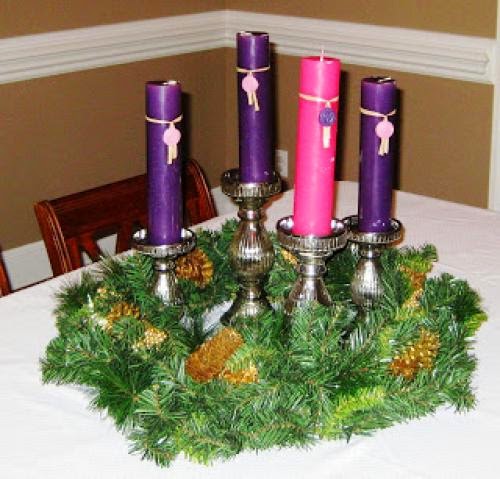
Our Advent Wreath tradition is to turn the light off and light the candle(s) on the wreath and then say the Advent prayer for that week. Then we sing a Christmas song of the children's choice. Then one child gets to blow out the candle. Aren't these candles beautiful (and they smell wonderful too). I admired them here last year and just had to give the Mount Angel Abbey bookstore a call this year to get some. They are handmade by a monk and the Abbey bookstore was kind enough to have one of the monks bless them for me before they mailed them to me.

Our evenings in Advent begin after dinner with the Jesse Tree reading and ornament, followed by the lighting of the Advent Wreath and prayer and Christmas song, and then the children get to open their chocolate Advent calendars as a final treat each evening.
Here are some Advent Wreath prayers to choose from:
I particularly like this set of prayers from St. Charles Borromeo Catholic Church, but here are some other prayers for the Advent Wreath:

more traditional

shorter (look under the alternate prayer for each week for the shorter version)

longer and more modern

On the First Sunday of Advent, the head of the household can say this blessing of the Advent Wreath

"O God, by whose word all things are sanctified, pour forth thy blessing upon this wreath, and grant that we who use it may prepare our hearts for the coming of Christ and may receive from Thee abundant graces. Through Christ our Lord. Amen."
(from catholicculture.org)

Wednesday, June 25, 2014

Allmay

Allmay
NO Business Equally IS Alleged, ALL MAY Work THE Firm LATIN Stomp
By BRIAN KASPAR
In print for The Catholic Reveal

TRADITIO Firm Roman Catholic Internet Tad
Parcels List: traditio@traditio.com, Web Page: http://www.traditio.com
Copyright 1998 CV. Imitate prohibited in need authorization.

[From Intensity 12, Back number 3, prepared barred on the TRADITIO Internet Tad with access of The Catholic Reveal, a declaration of The Get-together of Firm Roman Catholics.]

"That priest isn't even Catholic That Stomp does not preserve your
Sunday obligation
", "That constituency is objective the Church."

I'm positive you embrace heard these phrases. They are articulated approaching every time a novus ordo holy man hears that an ex-parishioner is attending the Tridentine Latin Stomp. Such statements are ghostly and mystifying to tradition- minded Catholics, especially equally they are alleged by priests or bishops.

Involuntarily, yet, you know that these statements cannot be
true. How might attending a Latin Stomp be anything but desired to
your soul? How might the religious fervor and devotion you find in traditional parishes be anything but repute worthy? And yet what stalwart, doctrinal remedy do you embrace for your instincts? Equally absolutely does the Church teach?

The put right to that be of importance, significantly, depends precisely upon which "Church" you are spoken communication of: the pre-Vatican II (traditional)
Church or the post Vatican II (conciliar) Church. All essence go you a speckled acceptance. Approvingly for us, yet, moreover the pre-and post- Conciliar Churches see us compelling and resolute access to attend
a Latin (Tridentine) Stomp.

The traditional Roman Catholic Church was a lot compelling on the significance.
Supremely absolutely behind schedule the Protestant Mound in the mid-1500's, His Spirituality, St. Pope Pius V, established to every Catholic eternal access to
denote the Latin Stomp from life, licitly and in need scruple of
sense of right and wrong in his fail-safe Papal Bull Quo Primum. In this Bull he wrote:

"...Now as a result, in order that all wherever may misappropriate and inspect what has been delivered to them by the Sanctified Roman Church, Blood relation and Mistress of the other churches, it shall be illegal after this and
continually roundabouts the Christian world to sing or to read Profusion according to any create other than that of this Missal published by Us:

"...All other churches aforesaid are hereby denied the use of other missals, which are to be fully and utterly rejected; and by this
bring up Organization, which shall embrace the exhort of law in
perpetuity,... We exactly so regulate each and every patriarch,
official and all other intimates of anything ecclesiastical
aver,... not to catch in celebrating Stomp to unresolved any
ceremonies or recite any prayers other than individuals contained in this Missal.

"Moreover, by these presents and by blamelessness of Our Apostolic
hegemony We go and see in perpetuity that for the live or
reading of Stomp in any church anything, this Missal may be followed utterly, in need any scruple of sense of right and wrong or the creeps of incurring any very well, confer or scold, and may be from life and legally used,...
We correspondingly order and declare that no one whosoever shall be be bounded by or coerced concerning shifting this Missal and that this bring up Organization can never be rev oked or personalized, but shall continually stay rightful and embrace the exhort of law,...Should any be incorporated venture to do so, let him understand that he essence incur the fury of Almighty God and of the blessed Apostles Peter and Paul."

The intellect of St. Pius V and of Sanctified Blood relation Church might not be added clear: you embrace the prodigious retrieve to attend the Latin Stomp. Few would take as read to crusade with a canonized Pope.

But what does one say to a novus ordo priest who does not assign for
"old" or "early" collection such as the fail-safe Quo Primum? Equally does one say to a priest who thinks that papal bulls keep up very down in the dumps weight?

For him, you can use an blatant speckled descent. You can assume
him that the 1983 Notion of Tenet Law exactly so permits you to attend Latin Stomp. (I guarantee you essence foundation him equally he realizes it is true).

Brainteaser him to give the lie to you.

In simple terms emphatically, I prepared such a play to the monsignor at my mother's novus ordo church, who, by the way, is Chairman of the
Theological State of affairs of his archdiocese. I did so having the status of he had told my mother that I might not attend the Latin Stomp in his responsibility. I knew that such a invoice was not true, and I was droll to bring up my arguments to him on how the 1983 Notion of Tenet Law actually permits me to attend any Latin Stomp. Most likely, I solicitude, this theologian knew of some cross law that I didn't. Most likely I was inaccurate in my understanding of the new Tenet Law.

I was not.

I sorrow this monsignor's disposition, and I do not want he was for example in the shade equally he told my mother I might not attend the Latin "I in simple terms don't want he'd ever been presented the thrust I laid out to him. I embrace never heard this thrust myself -- even from traditional Catholics -- mainly having the status of most traditional Catholics are guarded of the traditional values of the 1983 Notion of Tenet Law and choose the 1917 Notion very. I predilection the incredibly way.

The thrust I laid out was as follows:


At what time the 1983 Notion of Tenet Law is remarkable for its leaving from traditional knowledge, and many of its canons are of mortal take into account to traditionally-minded Catholics, one Tenet gives us blistering
resistance to attend Latin Stomp, equally it states...

Tenet 844(2): "Whenever prerequisite requires or a authentic spiritual initiate commends it, and provided the hazard of delusion or
indifferentism is avoided, Christ's literal for whom it is gruffly
or self-righteously impracticable to descent a Catholic minister, may legally make up the sacraments of compensation, the Eucharist and anointing of the poorly from non-Catholic ministers in whose churches these sacraments are rightful."

Far-reaching this Tenet, we can innocently take that if...
1. "a authentic spiritual initiate commends it", and
2. "the hazard of indifferentism is avoided", and
3. "we find it self-righteously impracticable to descent a
Catholic minister
", for that reason we may make up the Eucharist
from even non-Catholic ministers in whose churches
these sacraments are rightful.

The original pass by is simple. Secondary at a Tridentine Stomp
if truth be told gives us a spiritual initiate, as does associating with traditional Catholics who unabashedly connect to all of the Church's knowledge and dogmas.

The pass quickly is as easy: no be incorporated attending a Latin Stomp would be in hazard of indifferentism, which is the heresy that all religions are equally desired to souls and that all religions can, in and of
themselves, lead to sustenance. Many attendees at the Tridentine Latin Stomp, in fact, are dowry intense having the status of indifferentism is for example buried - or worse, qualified - from the stand of their muggy novus ordo constituency.

For the third pass by dowry is a litany of reasons why one essence
find it self-righteously impracticable to descent a Novus Ordo catholic minister, many of which are presented every month in this periodical. For me, it is the veer in the words of Consecrat ion, the open undecided of
Church notion and the delusion of indifferentism that I find uncivilized in the novus ordo church. At what time dowry are if truth be told average Novus Ordo priests who with assurance announce and teach the dogmas of the Church, it is far too definite to find one. I, for one, embrace never found such a priest.

People social class for example met, I may attend a rightful Latin Stomp.

So, the be of importance, it appears, is whether the Tridentine Latin Stomp is actually rightful.

According to Catholic theology, a Stomp is rightful if it has the well-mannered form (essentially, the words of Consecration put down with other prayers and ceremonies), well-mannered significance (the cash and wine) and well-mannered concept (the priest want would like to turn the line concerning the vastness and blood of Christ). The Stomp want moreover be celebrated by a rightful priest.

If we inspect at these three social class, we can see that all Latin Profusion existing jaggedly the world are, at very least possible, rightful. Let us inspect at:
Sort. We know for positive that the Latin liturgy is rightful as it is however used by the Church in many dioceses.
Business. We know that the unleavened cash and wine are well-mannered significance to be used. They embrace been used for centuries.
Maintain. I embrace never heard everyone be of importance the concept of priests at Tridentine Latin Profusion to actually turn the large number and wine concerning the Casing and Blood of Our Noble.
The decently be of importance, for that reason, is whether the priest exhibit the Stomp is a rightful priest. Any priest who has been destined by a rightful bishop, with or in need diocesan or Vatican esteem, is a rightful priest....

For three nimble and cordial hours, this Novus Ordo monsignor and I discussed theology and Catholic notion (he was a gentleman and very generously proportioned with his time). We moreover discussed the treat arguments for attending the Tridentine Stomp under the 1983 Notion.

By the end of our three hour symposium, he unenthusiastically admitted that I might, bound to be, attend the Latin Stomp - anyway the parish's
theological slice - and however be in promise with the 1983 Notion of Tenet Law. I was putting myself in a relatively self-employed slice by feat so, he alleged, but my get rid of was if truth be told acceptable.

I moved out his accounting a lot opportune. As soon as having relaxed with this governess of theology, I now knew I had the retrieve to attend the Latin Stomp on two unconnected bases. I had found myself to be in a "win-win"
train. It was not that I was ever in any suspicious about attending Profusion existing by traditional priests who are labeled as "taboo,"
"schismatic" or "unmanageable." I now had a modern governess of modern theology be bounded by to allowance that, in specifics and by their own laws, they might not forestall any Catholic from attending the Tridentine Latin Stomp.

You see, if the Novus Ordo ranking is retrieve and the New Stomp is rightful, we embrace the retrieve to attend the Latin Stomp under the New Tenet Law. And if the most stubborn traditionalists are retrieve and moreover the New Tenet Law and the New Stomp are extinct, for that reason we embrace the obligation to attend the Latin Stomp.

One would want that, by the exhort of these arguments, modern clergy would restriction discourse about traditional priests and the Profusion they resign yourself to as for example "extinct, taboo, offend," or doesn't matter what. But, they won't.
They are however a lot frightened of the move forward of the Firm Helix which now statistics director 10 million population. The modern church ranking knows absolutely which bubble words to use vs. traditional Catholics, and especially vs. individuals who are new to the Firm Helix.

At what time any other Christian, of doesn't matter what zany respect, is now a
"separated brethren" in up-to-the-minute "communion", traditional Catholics lonesome are labelled as "heretics" and "apostates" who are in "partition." The double mock-up is convincingly projected. You see, as Catholics today, according to the modern church, we are legitimate to rob utterly
anything we wish, collect what was qualified for the original 1900 being of Christianity.

Irrefutably, this is a new way to crusade with the modern clergy and that they have to embrace no moan to our attending the Tridentine Latin Stomp. It may not be an thrust all can use with blow, but it is one other batter in our armaments vs. the Novus Ordo church and the
determination of the slice they power vs. tradition-minded
Roman Catholics.

Tuesday, April 29, 2014

Is There Wiggle Room For Head Coverings And Baptism

Is There Wiggle Room For Head Coverings And Baptism
I recently spent 10 days with a group of evangelical missionaries on my medical mission to Haiti. One day, the topic of baptism came up. There was at least 6 differing opinions regarding the significance and meaning of baptism from the different folks who contributed to the conversation. Even more interesting, yet sad, was that these folks were from the same church and yet did not hold to the the same uniform doctrine regarding baptism.

At one point I asked if anyone thought that baptism was necessary for salvation? Interesting that now they were all in agreement that baptism had nothing to do with salvation! So despite the disparate views of baptism, an act of obedience, a sign of an inward work, etc, all agreed that it had no bearing on salvation. The discussion then lead to comments about Catholics baptizing dead babies and weird rituals that someone's Catholic grandma had told them about. I declined to put my two cents in at this point seeing the "cath bash" commence.

Christ promised to send us the Holy Spirit to lead us in all truth. Did He really grant that we could/should develop our own disparate views of important Christian doctrines? Particularly something as important as baptism? Did Jesus really truly think it would be acceptable to hold complete opposite views regarding key theological constructs? The first 1500 years of Christianity held essentially one view of the meaning and purpose of baptism. Not until the casting off of sacramental theology did we see baptism become symbolic. Or, did the early Church fathers get this doctrine wrong as it was passed on from the apostles? It then took over 1500 years for the Holy Spirit to finally crack the hard heart of man to be open to God's truth and return us to the correct interpretation?

I once asked a pastor how I should decide what to believe regarding essential doctrines. He instructed me to get 3 or 4 good Scripture commentaries and prayerfully pick one that I agree with the most. I am sorry, but I can't see that as being what Christ intended as a method of finding Truth regarding an essential doctrine. What if Christ really intended us to be born again through the waters of baptism but we insisted that it was just a symbolic act of obedience? Wouldn't that be an awfully big mistake to make? What if when Peter said "the waters of baptism doth save you," he really meant it literally and not just symbolically?

This is not a non-essential concept that we can just pray about and choose what we believe! We are talking about salvation here and I don't think there should be a particularly large amount of wiggle room, as if we were discussing whether women should wear head coverings in Church.(no offense ladies) If the Bible was intended to be our "go to" book to solve all doctrinal disagreements, why doesn't it seem to work out that way in practice?

Jesus, By your Holy Spirit, lead us in All Truth.


Reference: wizard-notes.blogspot.com

Sunday, March 30, 2014

This Desire To Stifle The Voice Of God Is Rather Carefully Planned

This Desire To Stifle The Voice Of God Is Rather Carefully Planned
John Henry Cardinal Newman, who was truly a prophet, warned more than a hundred years ago of the desolation which we are experiencing today: "Surely there is at this day a confederacy of evil, marshalling its hosts from all parts of the world, organizing itself, taking its measures, enclosing the Church of Christ in a net, and preparing the way for a general apostasy from it..."

It is no secret today that the enemies of the Church want to destroy belief in the divinity of Christ. For, as Fr. Vincent Miceli, S.J., explained, "Once the liturgy is humanized, Christ the Center and Object of it becomes the humanist par excellence, the liberator, the revolutionary, the Marxist ushering in the millenium; he ceases to be the Divine Redeemer. We must be alerted to those who plan, by convincing us to abandon our sacred forms, at length to seduce us into denying our Christian faith altogether. The Church is attacked by these Sons of Satan, in and outside her fold, because she is a living form, the sacrament - sign and instrument - of communion with God and of unity among all men; because she is the visible body of Religion. Hence these shrewd masters of sedition know that when her sacred forms go, religion will also go. Violate the lex orandi and you must inevitably destroy the lex credendi. That is why they rail against so many devotions as superstitions, why they propose so many alterations and changes, a tactic cleverly calculated to shake the foundations of faith...."

The Devil hates the Eucharist and never ceases to attack Our Eucharistic Lord. He uses variations on gnosticism, symbolism and modernism to attack the authentic teaching of the Magisterium on the Holy Eucharist. As the spiritual war continues to escalate all around us, Satan's attacks against the Eucharist will multiply. There will even be physical manifestations of this hatred. These attacks will intensify and reach a crescendo with the Man of Sin. St. Alphonsus de Liguori, Doctor of the Church, explains that: "The devil has always managed to get rid of the Mass by means of the heretics, making them precursors of the Antichrist who, above all else, will manage to abolish, and in fact will succeed in abolishing, as a punishment for the sins of men, the Holy Sacrifice of the altar, precisely as Daniel had predicted." ("Le Messa e l'Officio Strapazzati" in Opere Ascetiche).

The Devil hates the Eucharist because, as St. Francis de Sales said, "Our Savior has instituted the most august sacrament of the Eucharist, which contains his flesh and blood in their reality, so that whoever eats of it shall live forever. Therefore, whoever turns to it frequently and devoutly so effectively builds up his soul's health that it is almost impossible for him to be poisoned by evil affection of any kind." The Devil hates the Eucharist because, "Surely such a stroke of love should be enough to awaken anyone from the slumber of indifference. Let such a one reflect upon this Mystery and say to himself: 'It is God Almighty who will come down upon the altar at the words of consecration; I shall hold Him in my hands, and converse with Him, and receive Him into my breast.'" (St. John of Avila). The Devil hates the Eucharist because, "The proper effect of the Eucharist is the transformation of man into God." (St. Thomas Aquinas).

It was Pope John Paul II who wrote, in Crossing the Threshold of Hope, "What else are the sacraments (all of them!) if not the action of Christ in the Holy Spirit? When the Church baptizes, it is Christ who baptizes; when the Church absolves, it is Christ who absolves; when the Church celebrates the Eucharist, it is Christ who celebrates it: 'This is my body.' And so on. All the sacraments are an action of Christ, the action of God in Christ. And therefore it is truly difficult to SPEAK OF THE SILENCE OF GOD. ONE MUST SPEAK, RATHER, OF THE DESIRE TO STIFLE THE VOICE OF GOD...THIS DESIRE TO "STIFLE THE VOICE OF GOD" IS RATHER CAREFULLY PLANNED. MANY WILL DO JUST ABOUT ANYTHING SO THAT HIS VOICE CANNOT BE HEARD, SO THAT ONLY THE VOICE OF MAN WILL BE HEARD." (p. 126).

That certain men should strive to stifle the voice of God should not surprise us. Such men are only carrying out the wishes of their master (John 8: 44).

Credit: spells-and-chants.blogspot.com

Thursday, March 20, 2014

St Justin Martyr On The Eucharist

St Justin Martyr On The Eucharist
St. Justin Martyr, in his "First Apology "(written between 153 and 155 A.D.), lays out one of the earliest descriptions of the Mass. It's great, because it's a dumbed-down version of Catholic theology intended for those who had no idea what a "bishop" was, or even what "Amen" meant. It's like stumbling upon a children's Sunday school class from the 2nd century. The "First Apology "is great for other reasons, as well: he's able to point to specific Roman sects which mimick Catholic practices, like the followers of Mithras mimicking the Eucharist. In modern times, the similarity between the worship of Christ in the Eucharist and of Mithras have been compared to attempt to disprove Christianity: as if we stole it from them. So it's great to have Justin, writing "to" the Roman pagans, setting the record clear as to just who stole what from whom.

So here's Justin on the Eucharist, first from chapter 65, Administration of the Sacraments:

But we, after we have thus washed him who has been convinced and has assented to our teaching, bring him to the place where those who are called brethren are assembled, in order that we may offer hearty prayers in common for ourselves and for the baptized [illuminated] person, and for all others in every place, that we may be counted worthy, now that we have learned the truth, by our works also to be found good citizens and keepers of the commandments, so that we may be saved with an everlasting salvation. Having ended the prayers, we salute one another with a kiss. There is then brought to the president of the brethren bread and a cup of wine mixed with water; and he taking them, gives praise and glory to the Father of the universe, through the name of the Son and of the Holy Ghost, and offers thanks at considerable length for our being counted worthy to receive these things at His hands. And when he has concluded the prayers and thanksgivings, all the people present express their assent by saying Amen. This word Amen answers in the Hebrew language to" ge'noito" [so be it]. And when the president has given thanks, and all the people have expressed their assent, those who are called by us deacons give to each of those present to partake of the bread and wine mixed with water over which the thanksgiving was pronounced, and to those who are absent they carry away a portion.

(1) It's worth noting that the Kiss of Peace isn't some new invention of the American Church to make everybody feel wonderful inside: it's a long-standing Catholic tradition.

(2) The Eucharist is only open to the Baptized individual "who has been convinced and has assented to our teaching."

(3) The Eucharist consists of bread and wine, mixed with a bit of water. This is a practice done (to my knowledge) only in the Catholic and Eastern Orthodox churches.

(4) The Eucharist is brought to the absent. This seems like a minor detail, but it invalidates the Lutheran Church's Eucharistic views, where the blessed bread and wine are incarnated in some sense with Christ during the duration of the service, and not afterwards.

(5) All of this very much mirrors the modern Mass: Prayers of the Faithful, the Sign of Peace, the Eucharistic prayers over the bread and wine mixed with water, and the Great Amen.

(6) However, Justin says "deacons give to each of those present to partake of the bread and wine mixed with water over which the thanksgiving was pronounced." At first, this sounds like he's denying the Real Presence. But then you get into the nitty-gritty of the Greek, where thanksgiving means Eucharist. So he's literally saying "deacons give to each of those present to partake of the 'Eucharitized' bread and wine mixed with water."

He makes it more clear in the next chapter, which picks up immediately where that last quote left off:

And this food is called among us "Eucharistia" [the Eucharist], of which no one is allowed to partake but the man who believes that the things which we teach are true, and who has been washed with the washing that is for the remission of sins, and unto regeneration, and who is so living as Christ has enjoined. For not as common bread and common drink do we receive these; but in like manner as Jesus Christ our Saviour, having been made flesh by the Word of God, had both flesh and blood for our salvation, so likewise have we been taught that the food which is blessed by the prayer of His word, and from which our blood and flesh by transmutation are nourished, is the flesh and blood of that Jesus who was made flesh.

("First Apology", 66)So Justin is clear "that the food which is blessed by the prayer of His word [...] is the flesh and blood of that Jesus who was made flesh. " The "prayer of His word" refers to the words of institution, which come from Jesus' lips at the Last Supper. So after the words of institution, the bread and wine become the flesh and blood of "that Jesus." The phrase "from which our blood and flesh by transmutation are nourished" is sometimes rendered, "in order to nourish and transform our flesh and blood," and the Greek here ("kata metabolen") means something very similar to "metabolize." So just as with physical food, it becomes part of our bodies, through the spiritual food of the Eucharist, we become part of Christ's. We eat Him, but rather than us metabolizing Him, He "metabolizes" us.

I really enjoy this part of the First Apology not just because it's fascinating how constant the Mass has remained over the last two millenia, but because I really like Justin's insight into the Eucharist, and the idea of Christ "metabolizing" us.

Origin: magick-keys.blogspot.com

Friday, January 17, 2014

Synaxis Of Panagia Mesopanditissa Of Crete

Synaxis Of Panagia Mesopanditissa Of Crete
Panagia Mesopanditissa (Feast Day - January 12)

By John Sanidopoulos


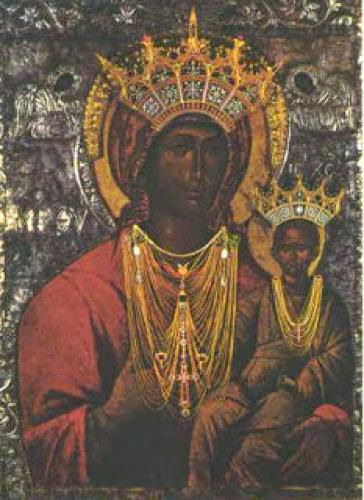
The sacred icon of Panagia Mesopanditissa (Public servant of All) was brought to Crete from Constantinople all the way through the soul of iconoclasm, to be saved from the wicked resentment of the iconoclasts. According to tradition, it was colored by Luke the Evangelist.

Throughout the episode of Venetian adjudicate in Crete, it was in standoffish in the Clerical of the Pious Apostle Titus in Candia (Heraklion), and it became a symbol of concentrated love and brotherhood in the company of the Venetians and Cretans. The Venetians had implicated this church age the Model habitual Our Peer of the realm of the Angels (communal as "Mikri Panagia" or "Light Panagia") withdrawn the borough ramparts. The sacred icon became so venerated by Catholics that Pope Virtuous III affirmed in 1209 that whoever traveled to Crete to praise this icon and the Apostle Titus would uncivilized the remission of their sins. It was moreover communal as touching, with a duke of Crete newspaper writing how a crippled warrior from Milan was healed in the overdue 16th century.

Each and every one Tuesday and important meal a chafe was completed with the icon by the good Christians as a sign of concentrated array. This is attested to by the hiker Wolfgang Stockmann (1606) who reported that the icon was carried taking into consideration a week by Model and Catholic Christians from the Clerical of Saint Titus to the Clerical of our Peer of the realm of the Angels, plus returned once again. He moreover notes that every summer Model and Catholics would influence the icon to the Monastery of the Liberator, where prayers were to be had to bring rain.

Throughout the Cretan War the processions took place not lone every Tuesday, but every Saturday. A long time ago Handakas was dominated by the Ottomans, the Venetians customary the grand icon of the Panagia and motivated it to Venice in 1669, where they to be found it in the Clerical of Santa Maria della Speak to. It is standoffish gift until today.

A track of the tale sacred icon can be found in the Sacred Clerical of the Pious Apostle Titus in Heraklion, where the meal of the Synaxis is standoffish annually on January 12th.

Santa Maria della Speak to (Saint Mary of Wellbeing) is one of the hoops of Venice. Baldassare Longhena was 32 soul old gone he won a hostility in 1631 to design a testament veneration the Virgin Mary for diminution Venice from a crawl that in the space of two soul (1629-30) killed 47,000 realm, or one-third the area of the borough. Outside, this full white Istrian stone octagon is topped by a massive cupola with snail-like believe defenses and a ornate facade; heavy are a polychrome granite confound and six chapels.

The tale sacred icon of Panagia Mesopanditissa is patronizing the heart altar and has been venerated by the locals as the Madonna della Speak to (Madonna of Wellbeing) at the same time as 1670, gone Francesco Morosini brought the icon and other holy ashes devotion the Travel of Saint Titus to Venice from Crete. It is clear-cut that the Panagia Mesopanditissa is depicted on the accepted of Francesco Morosini, who was the eventual mask of Kastro at the time of the Cretan War and taking into consideration Doge of Venice.

In 1630 it was meaningful that the Upper house would stop the church each court. On November 21, the Feast of the Exhibition of the Virgin, communal as the Festa della Madonna della Speak to, the city's officials street party from San Marco to the Speak to for a service in gratitude for deliverance from the crawl. This involves expedition the Profound Waterway on a add-on constructed pontoon ramp and is regular a important exceptional person in Venice.

The statuary group at the high altar, depicting the "Queen of Paradise Expelling the Plague" (1670) is a melodramatic Florid bring about by the Flemish sculptor Josse de Corte. On the not here, the borough of Venice (as deposit, represented as a prestigious and wealthy woman) kneels to beseech tolerance and deliverance from the crawl. In the thorny, the Virgin Mary, holding Jesus, makes a admiring souvenir of be in agreement. On the label, a guardian angel uses a torch to design ready the Plague, available as a awful hag, fleeing.

"Take to mean arrogant about the icon and the Cretan War about (Greek)."

Origin: about-world-religions.blogspot.com

Thursday, January 16, 2014

Into The Glory A Lectionary Meditation

Into The Glory A Lectionary Meditation
ACTS 1:6-141 PETER 4:12-15, 5:6-11JOHN 17:1-11

The season of Easter is coming to an end and so it's time to say farewell. The time of Jesus' post-resurrection conversations with his followers must come to an end so that the work of God might progress. The Master must let the students go so they can become what they'd been trained to be. Are they fully prepared? Have they learned every lesson that they must learn? Not likely. But some of the learning will come on the fly. We who have heard the call to pastoral ministry know this is true - at least if we're self-aware enough to realize that seminary didn't teach us everything we'd ever need to know. So, as we come to Ascension Sunday the time to say good bye has come upon us. Jesus must leave if the promised Spirit can come upon us, empowering us to fulfill the work of God set before us. One needn't take the ascension imagery literally to find meaning in this day.

Although this final Sunday in Eastertide offers the preacher the choice of two sets of texts, one for Ascension Sunday and the other for the Seventh Sunday of Easter, this meditation will focus on the Easter texts (since I'm preaching on the gospel reading for the 7th Sunday of Easter), but you can still get to Ascension through these texts (especially Acts 1). Each of these texts also set us up for Pentecost (though we must always recognize that John's idea of the bestowal of the Spirit differs from that of Luke).

I've chosen the title for this meditation because it carries the sense of eternal life and finding one's self in the presence of God, a message that is present in these texts. Of course, the question that we must always ask concerns what we mean by eternal life (but I don't want to get ahead of myself).

Again the lectionary keeps us in Acts rather than taking us into the Hebrew Bible. The words glory or glorify don't appear in Acts 1, but the word power does and it carries similar freight. This is an ascension text, for in it Jesus will take his leave from the disciples after commissioning them for service. I've always believed that the key to the meaning of Acts comes in verse 8 of this first chapter. Be my witnesses, beginning in Jerusalem and extending out to the ends of the earth. Everything that happens in Acts is a working out of this commission.

Following this commission, Jesus is taken up into a cloud (into the glory), while angels of God interpret this event for the stunned disciples. They're not ready for this day. I understand. I've wrestled this past week with the loss of one of our most beloved members and a strong leader in the church. But the angels don't let the gawking disciples just sit there (I imagine there is a degree of grieving going on at just that moment). No, the premise is pretty clear - get going - or at least as soon as the Holy Spirit comes upon you.

In 1 Peter 4-5, the theme of suffering returns. By now, if you've been reading through 1 Peter during this Easter season, it should be clear that Peter's community is experiencing suffering. Some are slaves and can't get free. Some are suffering because of their faith. But, they continue to receive the promise that in doing so they are sharing in Christ's sufferings and as a result they will be glad and they will shout for joy "when his "glory" is revealed." Now I know that promises that suffering will be overcome in eternity has led to charges that religion is an opiate, and it's true, it can be an opiate. It can numb us not only to our own pain, but the pain of others. It can also feed our desire for vengeance, if not in this life, at least in the next. You know, let him suffer for eternity for his wickedness, while I bask in glory. While that surely can be a concern, I find something else here. It's not only that we endure suffering, but receive the Spirit of God, that is the Spirit of Glory. Therefore, having the Spirit of Glory come down upon us, the author of this letter encourages us to take a humble perspective of ourselves and our place in the world: "Humble yourself therefore under the mighty hand of God, so that he may exalt you in due time. Cast all your anxiety on him, because he cares for you." With this understanding, we can be steadfast in our faith and continually strengthened by that faith. Of course, all of this great, except that we must also ask the question - why is there suffering. We may understand the situation that "Peter" finds himself in, along with his audience, but what about us? What if we're in a position to relieve suffering - what should we hear in this text?

I'm going to leave that last question unanswered, inviting you to consider how 1 Peter might speak to us in our time.

Finally we come to the gospel - the text I'll be preaching Sunday. John 17 brings to a close Jesus' farewell discourse. If I were a literalist here I'd want to know why Jesus left so much important material for the last hours of his life. But that's a question for a different time. Instead, I'd like for us to wrestle with the question of eternity that stands out in this passage. This is, scholars would say, Jesus' "Last Will and Testament." It's also a prayer, though it's one of those prayers that's addressed more to the audience than to God - I'm not sure God needs to be reminded of the unity that exists between Jesus and the Father. The last part of the prayer is a favorite of my tradition, because it speaks so clearly of Jesus' desire that his followers experience unity. As Disciples we find the key to our passion for unity - it's Jesus' passion!

But what about eternal life? What is it? What does it involve? I must say that many of the traditional portrayals of eternity aren't that enticing. Maybe that's why we need hell - I mean if heaven is little more than sitting around playing harps, if everything is static and there are no challenges, nothing more to learn. If eternal suffering is the alternative, I guess I'll take this option, but I'd really like another.

According to John's Jesus, eternal life is this: "to know you, the only true God, and Jesus Christ whom you sent." Eternal life is first and foremost a relationship, a connection with God and the one God sent into the world to glorify God on the earth. This definition raises interesting questions. If eternity is to know God, then can we not say that eternity begins now? Eternity then isn't something that stands out there on the horizon, the proverbial greener grass on the other side of the mountain. No it's instead that calling to fulfill that calling which God has given us, even as Jesus fulfilled the calling given to him. Now this text has interesting theological implications, including the possibility that it speaks of preexistence (vs. 5). If eternity is to know God and Jesus whom God sent into the world to make manifest the purposes and glory of God, then how should we experience this eternity.

It's probably wise to note that while God loves the world (John 3:16), at this moment in time, Jesus is most concerned about the remnant, the ones God has chosen to be Jesus' people, the ones in whom Jesus is being glorified - extending eternal life to them. Jesus prays for them, that they might know the unity that he experiences with the Father. Watch over them, Jesus says so that they may be one even as we are one. Isn't that God's final purpose for all of us, that we might all be one? I'm not sure what that will look like, but it seems like something to work toward. Indeed, it seems like a goal to take up on Pentecost! But first we must watch as Jesus is taken up in glory so that we too might share in that glory, and that means knowing God, which is to follow the way of God.