
Wicca is a modern pagan, witchcraft religion

Wicca is a diverse religion with no central authority or figure defining it.

Wicca often involves the ritual practice of magic, though it is not always necessary

Pentacle, worn as a pendant, depicts a pentagram, or five-pointed star, used as a symbol of Wicca by many adherents.

Beliefs in Wicca range from hard polytheism to even monotheism.

Wicca is typically duotheistic, worshipping a god and goddess traditionally viewed as a mother goddess and horned god.

The term Wicca first achieved widespread acceptance when referring to the religion in the 1960s and 70s

Application of the word Wicca has given rise to "a great deal of disagreement and infighting".

The Goddess and the God may be regarded as the Divine Feminine and the Divine Masculine

The God and Goddess are generally seen as lovers and equals, the Divine Couple who together co-create the cosmos.

Traditionally the God is viewed as a Horned God, associated with nature, wilderness, sexuality, hunting and the life cycle

The Horned God is given various names according to the tradition, and these include Cernunnos, Pan, Atho and Karnayna.

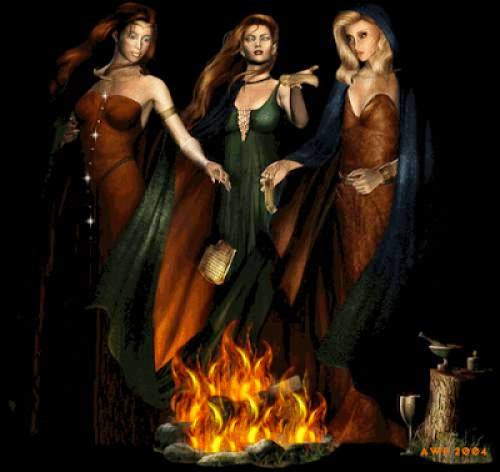
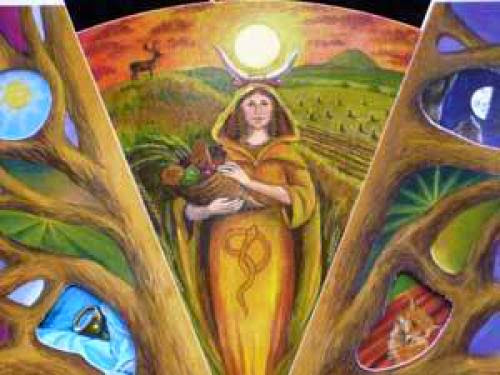
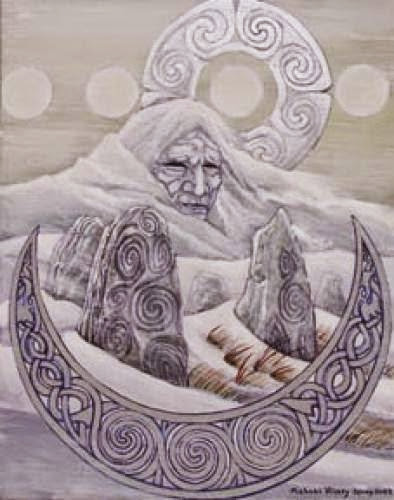
The Goddess is usually portrayed as a Triple Goddess, thereby being a triadic deity comprising a Maiden goddess, a Mother goddess, and a Crone goddess

Some Wiccans, particularly from the 1970s onwards, have viewed the Goddess as the more important of the two deities, who is pre-eminent in that she contains and conceives all. In this respect, the God is viewed as the spark of life and inspiration within her, simultaneously her lover and her child.

Showing posts with label theism. Show all posts

Wednesday, January 1, 2014

As The Light Returns

As The Light Returns
Slowly the days in Glasgow are getting a bit longer. We've had a very wet winter so far with lots of dark cloud cover. Days where you could see the sun or a patch of blue sky have been rare but slowly, so slowly the light is returning.

And as the days begin to get longer although it is still often cold, wet and windy our thoughts turn to the changes in the land and the Goddess whose names include "Seeks beyond". Imbolc is both a time for searching out the first signs of spring and a day devoted to the Goddess Brighid, known by many names and titles.

She is the named deity of this group, special to many of us in different ways. She is Lady of hearth and home to some, midwife and healer to others and source of the flames of inspiration to many. To some She is Goddess of Spring, to others Lady of the Dawn. She enfolds all of these and more still. She is Brigantia, Bridey and Brighid. And Imbolc is the festival most devoted to Her in her many guises.

We will be gathering on Sunday 2 February in Pollok Park at 1pm for our Imbolc celebration. Hope to see old friends and new there.

Please note that if the weather is unsuitable for gathering outdoors there is an alternative venue that we use in the social area of the Bishopbriggs Media Centre. Please contact us to ensure you attend the correct venue.
Saturday, September 28, 2013

Allama Muhammad Iqbal On Tasawwuf

Allama Muhammad Iqbal On Tasawwuf
The Sufis of the earliest days of Islam were ascetics. Austerity and a God-fearing piety were their real concerns. In the Tasawwuf of later times metaphysics and theorizing mixed. Tasawwuf then ceased to be mere asceticism and mingled with philosophy. Hama Ust [All is HeJ, the slogan of the pantheists, is not a religious but a philosophical theme. Islam has nothing to do with wahdat and kathrat. The essence of Islam is Tawhid opposite of the latter is not kathrat but shirk. Any philosophy or religious teaching that prevents the blossoming and maturing of the human personality is worthless. Tasawwuf has inflicted much damage on the scientific spirit. People run after amulets instead of consulting a physician. To shut one's ears and eyes to the material world and to emphasize only the inward perception is a sign of stagnation and degeneration. It is the search after easy ways instead of making the effort for the conquest of nature by dynamic struggle. I think the forbidden tree means Tasawwuf. Pure Islamic Tasawwuf is that in which the divine injunctions become imperatives ensuing from one's own wishes:

The Believer isn't known by a casual look.

Though reciter he seems, yet himself is the Book.

"Iqbal, the Poet-Philosopher" p. 53-54

Credit: spells-and-chants.blogspot.com

Monday, July 22, 2013

Transformation In Mission Part 2

Transformation In Mission Part 2

INCLUSIVE EVANGELISM - PART 2

So how does Daniel Kikawa present God to the Japanese, Korean's or Chinese, etc.? Speaking of the Korean culture, he says, "but when the protestant missionaries came in decades later and, and used the name of "Hananim", all of a sudden there was great excitement, that our God sent his son for us, Y'know, and so its not a foreign God anymore - our God," ("Word to the World" interview by Danny Lehmann with Daniel Kikawa Feb.13, 2006, #6).

His message and method is explained in his book "Perpetuated in Righteousness", "Instead of destroying and ridiculing the native names of the Creator God, we should help preserve them as a legacy for these peoples."

"Christians should cease representing Jesus as the Son of the foreign God of a foreign people. We should instead introduce Jesus as the Son of their creator God." (p.27, "Perpetuated in Righteousness" 4th ed.)

The Premise - The Creator God of the Bible is not a foreign god of these nations - their god sent his son. That "God" was involved in forming their culture. Give them the "God" they already worshipped and they will accept the message that their "God" is God who had a son (that is Jesus).

It should be immediately obvious to any student of the Bible what he has done. If Jesus is the son of their creator "God," in their culture-then he is no longer Jewish. Then God's special revelation to Israel is diminished or removed (Romans 3:1-2). You then have a different Jesus, and certainly a different God. Which produces a different Gospel (Gal.1:6-9; 2 Cor. 11:3-4). This becomes a replacement theology of a different sort.

In his video, "God's Fingerprints in Japan", he speaks of "Three Deities performed the commencement of creation" and compares this to the Trinity in Genesis 1:1-2. "Amenominakanushi" is flanked by the 2 other gods of creation; these three are separate from the other gods or kami of Japan."

Once again, as we looked into the primary resources we found that he forgot the next paragraph where there were two other deities, "The five Deities in the above list are separate Heavenly Deities" (p.15 "Kojiki"). Despite that the original three deities (3 gods) came into existence he Christianizes the myth to be like the Bible.

Kikawa's Mission Statement on his website basically explains his methodology: "The Creator God of the Bible is not a foreign God. He loves indigenous people and has been a part of their history and culture from the beginning."

In his video on the Japanese culture he states that we need "to look deeper to find how God has revealed himself in Japanese culture" (Video "God's Fingerprints in Japan" by Aloha Ke Akua Ministries).

Notice he says revealed in it, not to it. There is a major difference. This carries the meaning that God has put himself inside their (religious) traditions as stated in the video, "for it is in God's diversity that he gave the Japanese people their culture and it is in the culture they can find their identity in God." Yet the Bible says it differently: God had not revealed himself to the Gentiles as he did to Israel. They were foreigners, strangers to the commonwealth of Israel and to God (Ephesians 2:11-12).

Yet Kikawa's premise (referring to Romans 1) is that "The Bible says that all people had a knowledge of the creator. If this is true then we should find a creator God within the history and culture of Japan...."

Kikawa would have us believe that much of the culture they have today came through Buddhism. If God put it there, then we must accept Kikawa's false premise that God gave them the religion of Buddhism. If this is the truth, as Kikawa asserts, then God gave the "Kojiki" on Shintoism, and we must accept this as well as the beliefs of other religions.

THE TRUTH:


"And he said, I will make all my goodness pass before thee, and I will proclaim the name of the LORD before thee; and will be gracious to whom I will be gracious, and will shew mercy on whom I will shew mercy." (Exodus 33:19)

"And this is life eternal, that they might know thee the only true God, and Jesus Christ, whom thou hast sent." (John 17:3)

"Neither is there salvation in any other: for there is none other name under heaven given among men, whereby we must be saved." (Acts 4:12)

Saturday, September 29, 2012

Why Young People Are Attracted To Wicca

Why Young People Are Attracted To Wicca

By Catherine Edwards Sanders

In April of 2007, the Department of Veterans Affairs approved the use of the Wiccan pentacle-a five-pointed star surrounded by a circle-on tombstones at Arlington National Cemetery and other U.S. military burial grounds. The pentacle joins a list of 38 other approved religious symbols including an atom for atheists, the humanist emblem, and various forms of the Christian cross.

Wicca, long considered a fringe spiritual practice, has entered the mainstream and the number of practitioners has skyrocketed over the past decade. According to the American Religious Identification Survey1 conducted every decade by the City University of New York, the number of Wiccans in America was seventeen times larger at the beginning of this decade than it was in the early 1990s. Not only are there military personnel who practice Wicca, but many high school and college students do as well. Wiccans on college campuses have been forming their own clubs for years.

If we hope to engage this growing segment of our society-particularly the young people who practice Wicca-typical Christian tactics such as organizing boycotts, letter-writing, and shunning Wiccan believers, must become a thing of the past. Too often, Christians have refused to treat Wiccans as their neighbors and have been content to remain ignorant about what Wiccans really believe and why they believe it. We know that Paul on Mars Hill and other members of the early church looked with compassion on the pagans in their midst and effectively engaged them in conversations about the gospel. We must do no less with modern-day pagans.

Neo-paganism, or simply paganism, which includes the modern practice of witchcraft, also known as Wicca, is an overarching term for earth-based spirituality that incorporates nature worship into a polytheistic worship of ancient gods and goddesses. Wicca is also known as "The Craft," and most Wiccans believe in the manipulation of divine or cosmic forces through rite, ritual, and spell casting.

It is important to note, however, that Wicca is not a form of Satan worship. Wiccans worship and invoke pre-Christian deities and, like the ancient pagans, engage in earth worship. Wiccans will say that Satan is part of Christian and Jewish theology. There are Satan worshippers in the United States, however, who sometimes call themselves witches, which can be confusing. Wiccans do not deliberately invoke Satan. Whether or not they do so unwittingly is another matter.

Statistics tell us that three-quarters of practicing pagans are women. Estimates of the total numbers of practicing Wiccans in America vary wildly, as people can be reluctant to reveal their spiritual inclination publicly. Conservative estimates put the number at somewhere between 150,000 and 200,000. A poll2 conducted by a large pagan group put the number at almost 800,000, whereas some Wiccans claim that they number in the millions. Wicca is clearly on the rise and these numbers reveal a growing spiritual hunger for something that is not being met by traditional means.

WHY WICCA, WHY NOW?

I spent a year crisscrossing the country researching the answer to this question for my book "Wicca's Charm: Understanding the Spiritual Hunger behind the Rise of Modern Witchcraft and Pagan Spirituality".3 All of the young people I met were interested in spirituality, but not necessarily organized religion.

Why is Wicca on the rise and why does it appeal particularly to young people? First, young people are drawn to Wicca because it has no orthodoxy and has no concept of absolute good or absolute evil. This is greatly appealing to impressionable young people. There are some common practices, rituals, and sayings, but for the most part practitioners can add and subtract to it at will. It is a perfectly postmodern religion. One high school student said she liked Wicca because it was "malleable" and allowed her to create her own religion as it suited her.

Second, I found that young people turned to Wicca because they desperately wanted to believe in something that was "real." Too many had the false impression that Christianity was simply a collection of rules or nothing more than a boring church service. Teenagers often lacked a robust understanding of the Incarnation and had no concept of the Trinity. This lack of biblical literacy had led them to become easily impressed by magic and by the occult experiences in Wiccan rituals and practice.

Third, Wicca appealed to these young people because it promotes glorification of self. Unlike Christianity, in which God is essentially separate from creation, the gods and goddesses that Wiccans invoke are not. For instance, a young woman who might be feeling angry will take part in a ritual in honor of the Greek goddess of war Athena through which she can vent her anger, and another who might hope to fall in love will petition the goddess Aphrodite. Much of Wiccan ritual is designed to help women, in particular, draw on the power within-which is usually represented by the type of goddess they invoke. These young women enjoy worshiping goddesses, in part because one of their main complaints about the church is that they feel it is patriarchal.

Fourth, many young people embrace Wicca because they, like adult Wicca devotees, are bound by and to a passionate love of nature. Wiccans love the earth and care deeply for the environment. Some feel that the American church has been silent when it comes to stewardship of the environment.

Some of the complaints that Wiccans voice about the way Christianity is practiced have some merit, and I found that most Wiccans took issue with Christian behavior rather than with the gospel itself. Many of them had been disappointed by a pastor or wounded by someone in the church, and some of them had asked difficult questions about Christianity that no one had taken time to answer. Others simply refused to believe the gospel message. When conversing with Wiccans, it is important to approach the conversation with a gentle and humble spirit and to admit where the church might have failed them, but also to explain to them the glorious message of the gospel.

ENCOURAGING THE SEEKING SPIRIT


I have found Wiccans to be voracious seekers of knowledge. We must encourage this seeking spirit. They have one thing in common with Christian believers, and that is that they believe in the spirit world and thus want to live their lives according to some kind of spiritual practice. This common interest is a great place from which to launch a dialogue with a Wiccan.

In Acts 17, Luke describes Paul's interactions with the pagans in Athens. He waded into a pool of pagan thought and spent time there. Acts 17: 22-234 reads, "'Men of Athens! I see that in every way you are very religious. For as I walked around and looked carefully at your objects of worship, I even found an altar with this inscription: TO AN UNKNOWN GOD.'" Paul took time to walk around Athens and study the Athenian rites and rituals, their gods and goddesses. He did not simplistically condemn these men and women without knowledge of what they believed; in fact, he even complimented their religiosity!

If we find out that our children, friends, or other family members are interested in Wicca, the best approach is first to listen and find out what interests them about this belief system. Why are they drawn to it? What does it seem to offer that Christianity does not? It is important to become familiar ourselves with the practice of Wicca to engage in a conversation about it properly.

Parents must be able to give an articulate response about what they believe and why they believe it. It is usually not enough simply to ban the practice of Wicca in the home or to forbid any interaction with Wiccans. That usually motivates a young person to explore further-in secret. I met countless college students who couldn't wait to get to college so they could join the Wiccan club on campus away from their parents' watchful eyes. If a Christian parent forbids pagan practices in the home, it is vital that they also engage their children in meaningful conversations about their beliefs and gently challenge them with the message of the gospel. I found that young people are yearning for such meaningful conversations with their parents.

When talking to Wiccans, let them know that Christianity is real-that Christians believe that God became flesh, dwelt among us in the form of Jesus Christ, and left the Holy Spirit for His followers as a real presence of God here on earth. No god or goddess that Wiccans worship became incarnate, died once and for all for our sins, and rose from the dead. The gospel message is good news!

It is also important to point out gently where Wicca is inconsistent. Without a God who is perfectly good, there are no absolutes, no standards by which to measure what is just or unjust. Wicca borrows from Christian values of right and wrong. Wiccans might get upset at how women have been treated, but on what do they base their anger-that treating women poorly goes against their personal taste? Christians believe mistreating women is wrong because God said so. Christians also believe that all life has dignity because we are made in God's image. Wiccans don't believe this, but without this belief they have only shaky ground on which to condemn injustice.

When it comes to the environment, it is important to note that the Bible teaches that God delights in His creation, so we, then, are to be good stewards of His creation. Scripture reveals a God who created man and woman from dust, blessed this earth with His presence by taking on material flesh Himself, and promised a renewed earth. We must be honest and admit that professing Christians have not always treated God's creation with the care we should. It is not too late to start, however. Projects such as restoring a local wilderness area or including creation care in a Sunday school curriculum are simple. We should not be surprised at how much this genuine concern for creation would interest the Wiccan community and pique their curiosity.

As the number of Wiccans continues to grow, it is more important than ever for Christian believers to treat Wiccans in the same way we would treat believers of any other faith. If you meet a Wiccan and find yourself filled with fear, stop and pray. We have no reason to fear-for the power that is in us is greater than that which is in the world! I hope that this Halloween, Christians will pray for their Wiccan neighbors and reach out to them with the love of Christ.

NOTES


1. Barry A. Kosmin, Egon Mayer, and Ariela Keyser, "American Religious Identification Survey" (The Graduate Center of the City University of New York, 2001), 13. See also http://www.gc.cuny.edu/faculty/research briefs/aris/aris index.htm.

2. Kathryn Fuller, "Covenant of the Goddess", "Wiccan/Pagan Poll Final Results," Press Release, October 7, 2000, www.cog.org/cogpoll final.html.

3. Catherine Edwards Sanders, "Wicca's Charm: Understanding the Spiritual Hunger behind the Rise of Modern Witchcraft and Pagan Spirituality" (Colorado Springs: WaterBrook Press, 2005).

4. All Scripture quotations are from the New International Version.

Source: This article first appeared in the Effective Evangelism column of the "Christian Research Journal", volume 30, number 5 (2007).

Tuesday, September 20, 2011

Isis

Isis
Yule is the time of year when the Goddess gives birth to the God once again. For that reason it's a good time to acknowledge mother goddesses. I'm also a little miffed because another name blogger wrote that the goddess Isis wasn't a good association. This person has got it all wrong.

The origin of Isis (pronounced "IY-sis) is actually Greek and means "throne." No one knows for certain what name the Ancient Egyptians called her. In hieroglyphics, her name is sometimes written as "she of the throne." The reason the pronunciation of her original name is so disputed is because hieroglyphics have no vowels.

Isis is the daughter of Geb and Nut, gods of the earth and the sky, respectively. In addition to being the goddess of nature, reincarnation, and magic, Isis is also hailed as the ideal mother. And like a good mother, she doesn't pick favorites. She loves and will listen to the prayers of slaves and aristocrats with equal attention. She married her brother Osiris (incestuous marriages were common in ancient Egypt, so their mythology is going to reflect that). When her husband was murdered by Set, she used her magical skills to resurrect him (interesting side note, she had to learn his "secret name" in order to do this). During his resurrection, they conceived their son Horus.

Isis had her own cult that was popular throughout Ancient Egypt. She was so beloved that after the fall of Egyptian civilization, she continued to be worshiped in Greece, Italy, Spain, Germany, Arabia, Asia Minor, and even Britain. No one knows precisely what rituals were done in these cults. We do know that both men and women could be priests, that they were considered healers, and that some spells involved braiding or not combing their hair (this last part comes from the Egyptian belief that knots were magical, an idea that still exists in Wicca). Small parts of the Isis cult survived the suppression of goddess worship by Christianity. Isadore for boys and Isadora for girls are both Greek names meaning "gift of Isis" that are still used today.

Something else survived that makes Isis especially relevant to the Yuletide season. Isis is depicted in artwork in many ways, but one of the most common is when she's shown seated on a throne nursing her baby son Horus in her lap. Here's an example on the side. Does that image look a little familiar?

To be fair, I never read the Bible. But I had a college professor in art history who did and she said that the number of passages that mention the Virgin Mary, Jesus' mother, could be counted on one hand. She just isn't an important character. So where does all of the artwork of Madonna nursing baby Jesus come from? Many historians believe that even as Christianity grabbed hold over Europe, people still wanted a female role model to look up to. So they constructed the scene of Madonna and Jesus based on the earlier images of Iris and Horus. The theory makes sense if you think about it. They're both "the perfect mothers."

In modern day Neo-Paganism, Isis still plays a vital role even though we don't follow the same traditions that the ancient Egyptians had. She was recognized by The Order of the Golden Dawn, the coven Gerald Gardner was in before he started the Neo-Pagan movement. Kemetic Wicca follows the Egyptian pantheon and constructs rituals from The Egyptian Book of the Dead. Many feminist-based covens like the Dianic Wiccans adopt her as their patron goddess.

Wider culture in general is becoming familiar with the given name Isis. So far, it has reached the peak of it's popularity in 2005 and #522 in the top 1000 baby names. As for it's variations, Isadore was last widely used in 1910's and reached #328. Isadora is the rarest; as long as America has had the top 1000 it's never appeared. Despite that there are a few well known namesakes. Isadora Duncan is the most famous, considered to be the inventor of modern dance. And then there's Lady Isadora, a successful Pagan singer-songwriter and musician who was one of the genre's early founders.

Well, I hope I've made a good argument that Isis is a wonderful, feminine-yet-strong namesake for anyone to have. As you can probably tell, I like Isadora a whole lot.

Sources:


http://en.wikipedia.org/wiki/Isis

http://paganwiccan.about.com/od/godsandgoddesses/p/Isis.htm

http://www.babynamewizard.com/namipedia/girl/isis

http://www.babynamewizard.com/namipedia/boy/isadore

http://www.babynamewizard.com/namipedia/girl/isadora

http://www.ladyisadora.com/

Image Credit:


found via http://ffffound.com/

http://www.magictails.com/abydos/images/egyptian statues/large/egyptian statue isis horus sml.jpg

Friday, June 26, 2009

True Women Spirituality Dianic Wicca And Goddess Worship

True Women Spirituality Dianic Wicca And Goddess Worship
I've talked about this paper on WT before, and I ideal I even posted it everywhere, but I understood it deserved a repost. I wrote it a blind date or so ago for a Women's Studies course during my higher blind date of college. I long for you grasp and that it answers a few questions ever since raising some outstanding. It is repeated knowledge that women grip been cast down by the forceful religions of our time. Islam, Christianity, and Judaism all take in passages within their sacred texts that either present women as property, as less than men, or dead heat them as ignoble creatures that trap men to the ways of evil. Like of this, women's spirituality has suffered under these monotheistic religions. Women are not perfect whole thanks in provisions of fervent hierarchy, they are not legitimate to study religion at all, and/or they are stressed in the sphere of subservience based exactly on fervent texts. The exactly divine facade model women grip holds a indicate that is out of the question. The Virgin Mary, part of the Christian pantheon, is collectively naive and a mother, the two roles the monotheistic institutions wish to for women to accept. As the exactly female part of that pantheon, women grip no one excessively to play to for exercise. In the sticks of polytheism, women are stressed to strive for the slippery roles men and religion nose-dive upon them. But in attendance was a time before Christianity, before monotheism, that women had other divine facade models to play to. Divine being sweetheart was rash in to a great extent of Europe and in many other Pagan cultures of ancient grow old (Adler 42). Nevertheless these Goddesses were not the unfrequented deities worshipped, they did give up women a divine establish of power, a windfall to see in the sphere of their own god and be winning of who they were. These deities were strong, often in need relying on men, as in the case of Diana of the Roman pantheon (Adler 121). Represent were Goddesses of childbirth, which gave women an prospect to see this secular act as no matter which anointed (a expression that would agreeably transformation upon the backing of Abrahamic faiths), miserable with Goddesses of create and home as in Brigid of the Celts, who gave women a windfall to see their document routines and duties as principal to thecommunity, and many outstanding (Adler 20). It is no understand that, perfect the merciless weather conditions within the Judeo-Christian world for women, that Divine being sweetheart regained a when. It provided a extent women never classy within the inflexible set of instructions imposed on them by the church. It exceedingly provided a consciousness of honor for women within the Pagan community that was obviously without within the church. Downhill this renaissance in concentration in the Old Ways, a new tradition was formed-Dianic Witchcraft (Adler 121). Dianic Witchcraft is a tradition of Paganism that "maintains its connections with ancient matriarchies in provisions of myth and power" (Adler 122). Groups of these practitioners (called covens) sweetheart a Divine being in a monotheistic wear, still sometimes outstanding than one Divine being is received as in the case of a Dianic coven that follows the Welsh Celtic pantheon and worships Ceridwen, Rhiannon, Arianrhod, Branwen, and Blodewedd (Sisterhood of Avalon). Dianics see the Divine being in three aspects-"Maiden-Creatrix, Total Mother, and Old Crone", when the female life in a circle of virgin, mother, and discreet woman (Adler 122). In this in a circle, the Divine being does, sometimes, elucidate a male consort, but he is seen as less than herself, the benefactor of life (Adler 123). Historically, Dianic Witches grip seen Wicca as a "'womin's spirituality. Men are not allowed" from their practice (Adler 121). It is becoming outstanding repeated, still, for some Dianic covens to play male members (Starhawk 108). This began to transformation taking into account different gleam of Dianic Witchcraft became participating in in the to the front 1980s. Morgan McFarland started a weak small room of Dianic Witchcraft that is matching to its portent, but it acknowledges and, sometimes, worships male deities. She claimed that, "within the circle [the temple within whichwitches practice] all are whole not considering the 'feminist' edge" (Adler 123) not considering the fact that men might not have fun in the great burial of the coven. The use of the word "witchcraft" haughty should be noted. Commonly the tradition in be significant is termed "Dianic Wicca", but in attendance is a burgeoning motivation within the Wiccan community if the Dianic tradition might be decently included in the religion of Wicca. To understand why, one must understand what Wicca is. Wicca can be fixed as an earth-based religion that concerns itself with open-mindedness in humanitarian, the divine, and in oneself (Starhawk 41). Based on this definition, one without in workings but correct even, it is easy to see why some Wiccans would not manage Dianic Witches to be Wiccan. The magnitude of Dianic Witches place either great or all import on the Divine being(es) and childish to none on the God(s). This would suffering the open-mindedness within the divine in some Wiccans eyes. Nevertheless most Dianic Witches appropriate the patriarchal cuff in our lay world counteracts any disturb, this is demanding for many Wiccans from other traditions to play (Adler 122). So why do Dianic Witches manage themselves to be Wiccan? According to Kristine Jarvis: "Wicca differs from the superior monotheistic religions in its air towards women and in its eclecticism and egalitarianism...Wicca is a humanitarian religion that...good wishes male andprinciples and worships a god and a goddess, although in many forms of Wicca theappears to be forceful and is occasionally the unfrequented deity. Women's physicality is in difference to the outstanding unclear attitudes towards the female feature found in monotheistic religions. In its swell form, subsequently, it is compatible with a broad many free-handed, perspectives-particularly feminism and the Green movement." This definition of Wicca obviously has the Dianic tradition in mind with its amalgamation of the Divine being as the unfrequented deity. From this, we can obviously see why Dianic Witches would see fit to exhibit themselves in the Wiccan religion. Wicca's operate of women, the female form, and the Divine being would fit in the sphere of its heart beliefs. It is easy to see how feminists would consideration at home in a religion geared en route for the value of the female, the beauty of get-up-and-go a woman, and the extent and holiness of sexuality. As Starhawk says, "the feminist movement is a magicospiritual movement. It is spiritual in the role of it addresses the deliverance of the secular spirit, to healing our division, to becoming whole. It is magical in the role of it changes consciousness, it expands our implication and gives us new theory" (Starhawk 225). Dianic Witchcraft plainly takes this characterization and expounds upon it, bringing the spirituality of the feminist movement in the sphere of the front. It addresses character challenge and teaching in a religion with no gurus and no messiahs as feminism demands challenge for undecided our culture. It encourages women to be winning of who they are, as is one of the peak tenets of feminism. Ultimately, it insists that we not stand apathetically by and allow our world to be bent by others but that we elucidate an noisy facade in bringing about the changes we run in value of will. Wicca and, vastly, Dianic Witchcraft grip ad infinitum been inaccessible the widely held. Jennie Klein provides understanding to this in her report " Goddess: Feminist Art and Holiness in the 1970s"; "other femininity exercises bearing in mind deliberate marker, such as feminism or gay placement, feminist spirituality has ad infinitum remained on the limits of widely held culture and school reasonableness. To this day, the humanitarian Goddess/witch mold is depicted as wicked, abject, and sad." She goes on to say that it is simple that this form of spirituality is ill-omened to our Judeo-Christian the public which remains deeply based in patriarchy. But, "what remains less simple is the level to which feminist spirituality--particularly Divine being feminism-which feminist spirituality--particularly Divine being feminism--was a propos outstanding unsettling to feminist critics and academics than it was to the male radical" (Klein). So, even within the world of feminism, Dianic Witches exterior tirade. It seems they cannot fit in the sphere of any community, the feminists, the Wiccans, or the widely held. Gears Cited Adler, Margot. "Skill Glum the Moon: Witches, Druids, Divine being Flock, and One-time Pagans in America Currently". Revised and Long-drawn-out. New York, NY: Penguin Compass, 1986. 121-25. Mark. Jarvis, Kristine. "Gratifying a Woman in Wicca: Witches and Wiccans in Donate Youngster Fiction. Children's Copy in Basic knowledge" 39.1 (2008): 43-52. Web. 26 Feb 2010. a href="http://dx.doi.org/10.1007/s10583-007-9058-0%3E">http://dx.doi.org/10.1007/s10583-007-9058-0>;;. Klein, Jennie. "Goddess: Feminist Art and Holiness in the 1970s. Feminist Studies" 35.3 (2009): n. pag. Web. 26 Feb 2010. a href="http://search.ebscohost.com/login.aspx?">http://search.ebscohost.com/login.aspx?direct=true&db=aph&AN=47191497">Starhawk,. "The Soar Dance: A Rebirth of the Former Theology of the Total Divine being". 20th Silver jubilee. New York, NY: Harper One, 1999. Mark. "Because We Believe: The Goddesses. The Sisterhood of Avalon". 2008. The Sisterhood of Avalon, Web. 28 Feb 2010. /span>http://www.sisterhoodofavalon.org/SOA %20Website/1-the-goddesses.htm>.