Wicca is a modern pagan, witchcraft religion

Wicca is a diverse religion with no central authority or figure defining it.

Wicca often involves the ritual practice of magic, though it is not always necessary

Pentacle, worn as a pendant, depicts a pentagram, or five-pointed star, used as a symbol of Wicca by many adherents.

Beliefs in Wicca range from hard polytheism to even monotheism.

Wicca is typically duotheistic, worshipping a god and goddess traditionally viewed as a mother goddess and horned god.

The term Wicca first achieved widespread acceptance when referring to the religion in the 1960s and 70s

Application of the word Wicca has given rise to "a great deal of disagreement and infighting".

The Goddess and the God may be regarded as the Divine Feminine and the Divine Masculine

The God and Goddess are generally seen as lovers and equals, the Divine Couple who together co-create the cosmos.

Traditionally the God is viewed as a Horned God, associated with nature, wilderness, sexuality, hunting and the life cycle

The Horned God is given various names according to the tradition, and these include Cernunnos, Pan, Atho and Karnayna.

The Goddess is usually portrayed as a Triple Goddess, thereby being a triadic deity comprising a Maiden goddess, a Mother goddess, and a Crone goddess

Some Wiccans, particularly from the 1970s onwards, have viewed the Goddess as the more important of the two deities, who is pre-eminent in that she contains and conceives all. In this respect, the God is viewed as the spark of life and inspiration within her, simultaneously her lover and her child.

Showing posts with label shatkona. Show all posts

Wednesday, June 10, 2009

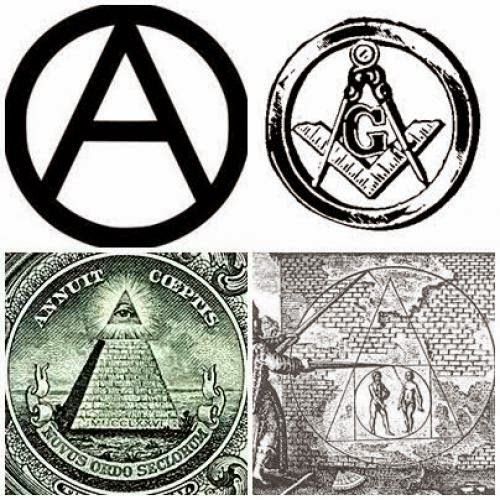
Freemasonic Roots Of The Anarchist Symbol

Freemasonic Roots Of The Anarchist Symbol
Detail of plate 1 from Spiegel der Kunst und Natur (Michelspacher Cabala), 1615, showing encircled A.

Freemasonic roots of the Anarchist Symbol


The first recorded use of the A in a circle by anarchists was by the Federal Council of Spain of the International Workers Association.

This was set up by the freemason, Giuseppe Fanelli in 1868. It predates its adoption by anarchists as it was used as a symbol by freemasons.

According to George Woodcock, this symbol was not used by classical anarchists. In a series of photos of the Spanish Civil War taken by Gerda Taro a small A in a circle is visible chalked on the helmet of a militiaman. There is no notation of the affiliation of the militiaman, but one can presume he is an Anarchist. The first documented use was by a small French group, Jeunesse Libertaire ("Libertarian Youth") in 1964. Circolo Sacco e Vanzetti, youth group from Milan, adopted it in and in 1968 it became popular through out Italy. From there it spread rapidly around the world.

Taurus or the symbol of a Bull:


Star of David, Seal of Solomon Hindu Shaktona equivalent to the symbolism in ritual magic. The Shatkona is the combination of the Shiva kona (trikona, triangle), the symbol of the God Shiva, representing the element of fire, and the Shakti kona, representing the element of water. Together, they represent the union of male and female, and the heart chakra.

Square Compass and hexagram


Origin: animals-and-shamanism.blogspot.com