Wicca is a modern pagan, witchcraft religion

Wicca is a diverse religion with no central authority or figure defining it.

Wicca often involves the ritual practice of magic, though it is not always necessary

Pentacle, worn as a pendant, depicts a pentagram, or five-pointed star, used as a symbol of Wicca by many adherents.

Beliefs in Wicca range from hard polytheism to even monotheism.

Wicca is typically duotheistic, worshipping a god and goddess traditionally viewed as a mother goddess and horned god.

The term Wicca first achieved widespread acceptance when referring to the religion in the 1960s and 70s

Application of the word Wicca has given rise to "a great deal of disagreement and infighting".

The Goddess and the God may be regarded as the Divine Feminine and the Divine Masculine

The God and Goddess are generally seen as lovers and equals, the Divine Couple who together co-create the cosmos.

Traditionally the God is viewed as a Horned God, associated with nature, wilderness, sexuality, hunting and the life cycle

The Horned God is given various names according to the tradition, and these include Cernunnos, Pan, Atho and Karnayna.

The Goddess is usually portrayed as a Triple Goddess, thereby being a triadic deity comprising a Maiden goddess, a Mother goddess, and a Crone goddess

Some Wiccans, particularly from the 1970s onwards, have viewed the Goddess as the more important of the two deities, who is pre-eminent in that she contains and conceives all. In this respect, the God is viewed as the spark of life and inspiration within her, simultaneously her lover and her child.

Showing posts with label 1st millennium. Show all posts

Wednesday, June 6, 2012

Vatican Europe

Vatican Europe
In this as an individual out of work outlet (the ager vaticanus) on the converse barrier of the Tiber from the urban of Rome, Agrippina the Big (14 BC - 18 October AD 33) miserable the mount and outer reaches and built her area in the ancient 1st century AD. Sovereign Caligula (37-41) started foundation of a rational that was forward-thinking finished by Nero, the Non-discriminatory Gaii et Neronis,traditionally called, frankly, the Non-discriminatory of Nero. The Vatican obelisk was as an individual diligent by Caligula from Heliopolis to shade the spina of his rational and is in this manner its survive definite find. This outlet became the site of martyrdom of repeated Christians in the rear the remarkable fire of Rome in 64. Foggy tradition holds that it was in this rational that Saint Peter was crucified upside down. Contra the rational was a necropolis at odds by the Via Cornelia. Interment monuments and mausoleums and less significant tombs as well as altars to pagan gods of all kinds of polytheistic religions were constructed stable until or else the foundation of the Constantinian Basilica of St. Peter's in the unusual curtailed of the 4th century. Fire at of this ancient necropolis were brought to light infrequently voguish renovations by changed popes due to the centuries growing in commonness voguish the Reappearance until it was exhaustively excavated by directions of Pope Pius XII from 1939 to 1941.

Origin: esoteric-soup.blogspot.com
Sunday, July 3, 2011

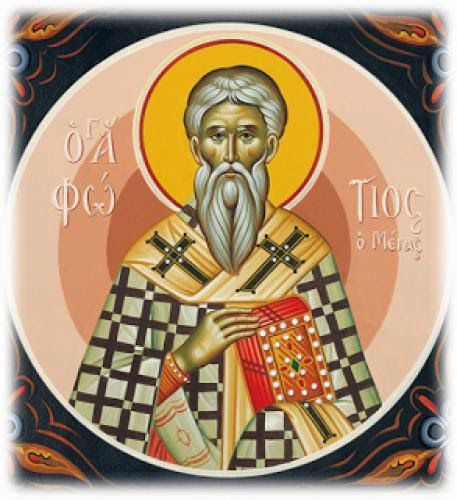
Saint Photios The Great As A Model For Our Lives

Saint Photios The Great As A Model For Our Lives
St. Photios the Great (Feast Day - February 6)

By Protopresbyter Fr. George Papavarnavas

He was a great personality of the ninth century, who came from a prominent yet pious family of Constantinople. According to the sacred Synaxarion, his father was distinguished for his correct faith, and his mother too was a lover of God and a lover of virtue. The Saint himself, in his 145th epistle, praises his parents and says that they both died as confessors. Having studied Greek literature, rhetoric and medicine, he offered much to the Church and to education. He became an important teacher, as well as a superior physician who was able to manufacture medicine that was very beneficial. "He was not only a superior teacher, but also an important listener, and considered worthy of gratitude one who put forward an opinion better than his. At the same time he offered his medical expertise to various patients, preparing himself and the medicines very effectively. This is why his contemporaries compared him with Galen and Hippocrates."

The exterior biographical elements of a saint do not usually show a lot of interest, if not associated with their entire personality and their inner life, which is carefully hidden from the world. From birth to repose there usually is nothing extremely impressive, especially for those who are impressed by surface matters and have not learned to look for the depth and cause of events. Of course the one whom we are writing about had many talents on the outside, but what made him great was primarily his love and obedience to Christ and His Church, which were the guiding principles of all his acts and actions.

In a critical period for the Byzantine Empire he came to the throne of the Patriarchate of Constantinople, which he brightened. During this period there was revealed his cleverness, ingenuity and his mental greatness. The Church was besought by strife and fanaticism. The supporters of the deposed Patriarch Ignatius tried to restore him to the throne by fending off Photios. The Frankish Pope of Rome Nicholas did not recognize him as the canonical Patriarch, not because he wanted Ignatius or cared about the internal matters of the Church of Constantinople. What he actually sought was to restore the issue of "primacy", namely that the Pope has primacy, not of honor, but of power over other Churches, as the successor of the Apostle Peter. He also coveted the region of Illyria. He wanted to subjugate the Bulgarians and for this reason sent Frankish missionaries. However, this area belonged to the jurisdiction of Constantinople. Photios, unsurprisingly, reacted like lightning. He organized Orthodox missions to the Slavs led by his pupil Cyril with his brother Methodios. The Franks were forced to leave and then the angry Nicholas fought him furiously. And as we will see below, the Franks fought him even many years after his death, and I would probably say until today.

But Photios knew how to tackle the issues calmly, with both a program and strategy. He knew very well what he wanted, but he also knew how to bring it about. As a true leader, he was ahead of the events. He did not allow them to catch on and be left to laggardly crawl behind. Moreover, a true leader is one who has the ability to see from afar and can anticipate unpleasant events, which, many times, can have a serious impact and shape history. Maybe today, without Photios, the Slav states would be under the influence of the Pope. And for this reason alone we owe him a lot.

He came to the height of critical circumstances and contributed greatly to the unity of the Church. For there is no greater sin than to break the unity of the members of the Church. The creation of factions by unwise people of the flesh harms unity, and rips the seamless robe of Christ.

But his great spiritual stature, praised even by his enemies and opponents, has not been honored as is due and to many he is completely unknown. Sacred Churches do not honor his name. Perhaps there is one or two in all of Greece. In the Menaion of the Church his Services are not registered on the day of his commemoration, but in the end as an appendix. This certainly is the case also with other major theologians and preachers and confessors of the Orthodox faith, such as Saint Gregory Palamas and Saint Mark the Evgenikos, always for the same reasons. We should not forget that during Ottoman rule our ecclesiastical books that circulated in Greece were printed in Venice and the papists did whatever they could to not include them in the Services of the Menaion, and they did this because they never "digested" them, because each one ruined their plans during their time and in their own way.

According to common confession, he was a great Hierarch and universal teacher. He was a carrier of the Greek Orthodox tradition and education, which does not aim to just transmit some knowledge, but it deals personally with man, the whole man, as a psychosomatic existence, and struggles to help him and give him a solution to his big existential problems and searches. The carrier of this tradition has spiritual nobility and bravery, but also is very sensitive. And as it is aptly observed by a known writer of the 20th century, "he digs deep into the soul of those of the same race, and elevates them, even in stages, to their humanity."

Source: "Ekklesiastiki Paremvasi", , February 1999. Translated by John Sanidopoulos.