Wicca is a modern pagan, witchcraft religion

Wicca is a diverse religion with no central authority or figure defining it.

Wicca often involves the ritual practice of magic, though it is not always necessary

Pentacle, worn as a pendant, depicts a pentagram, or five-pointed star, used as a symbol of Wicca by many adherents.

Beliefs in Wicca range from hard polytheism to even monotheism.

Wicca is typically duotheistic, worshipping a god and goddess traditionally viewed as a mother goddess and horned god.

The term Wicca first achieved widespread acceptance when referring to the religion in the 1960s and 70s

Application of the word Wicca has given rise to "a great deal of disagreement and infighting".

The Goddess and the God may be regarded as the Divine Feminine and the Divine Masculine

The God and Goddess are generally seen as lovers and equals, the Divine Couple who together co-create the cosmos.

Traditionally the God is viewed as a Horned God, associated with nature, wilderness, sexuality, hunting and the life cycle

The Horned God is given various names according to the tradition, and these include Cernunnos, Pan, Atho and Karnayna.

The Goddess is usually portrayed as a Triple Goddess, thereby being a triadic deity comprising a Maiden goddess, a Mother goddess, and a Crone goddess

Some Wiccans, particularly from the 1970s onwards, have viewed the Goddess as the more important of the two deities, who is pre-eminent in that she contains and conceives all. In this respect, the God is viewed as the spark of life and inspiration within her, simultaneously her lover and her child.

Showing posts with label celtic culture. Show all posts

Thursday, October 23, 2014

Moving On Towards The Summer Solstice

Moving On Towards The Summer Solstice
The Beltane ritual seems like a long time ago now. For the second year my mum, Siusaidh, was not well enough to attend Beltane. Unlike the previous year though it was a rotten cold that prevented her from being there and not a hospital stay. No mum also meant no dad (Piet) present either so I ended up coordinating an unscripted ritual with those who were able to be there. All of us present talked about what we would like to include in the ritual, it was very much a group effort and I think it went very well with some lovely healing energy raised for those we knew of in need.

The next week was the Druids of Caledon open Beltane ritual in Rouken Glen Park and my parents were well enough to be there. I had the pleasure of being at that one too.

For me though it doesn't quiet feel like Beltane until the hawthorn blossoms nearby so my third Beltane celebration took place a couple of weeks later and was a quiet acknowledgement of the changing of seasons.

Now we move towards the Summer Solstice and the days get longer and warmer although not often drier! Tuatha de Bridget will not be organising a Summer Solstice ritual this year. Instead we will be once again encouraging members to join the lovely members of the Druids of Caledon for their ritual on Sunday 22nd June at Rouken Glen park.

Please contact us if you need further details of where to go and what time.

Source: wicca-teachings.blogspot.com
Wednesday, October 8, 2014

Mid Summers Eve

Mid Summers Eve
INTRODUCTIONEve of 24th June (Saint John's eve or mid summers eve) was a popular time for festival. Fires were lit on hills and feasting and drunken bacchanalias took place around.Bonfire - bones burnt to drive away evil and protect the harvest. Wakefire was the burning of wood for merry making. Bones and wood burnt together was known as Saint John's fire.

The festival continued on mid summers day with various traditions including:Parades of giants and dragons, a feathered devil and naked boys.Lighting of bonfires and rolling of fire wheels on mid summers eve (wheel is Romano Celtic sun symbol). The first reference to rolling a burning wheel down a hill was recorded in 4th century.The carrying of fire around fields.Blessing of apple trees.Wassail bowls were decorated with ribbons and rosemary.The poem is set about the 15th century

MID SUMMERS EVE


The eve of the merry, feast of Saint John,A short night for to, gather herbs upon.The wise are picking, medicinal flowers,Two days after shortest, night's last hours.

The bones and wood, of Saint John's fire close by,Protecting the harvest, with bonfire high.Drive away evil, by burning some bone,Hang lanterns outside, cast out the unknown.

Wakefire of wood, for making merry,Jolly wassail bowl, ward off the fairy.Merrymaking into, the hours small,Into lechery, men and women fall.

Carry fire round field, fun in the revel.The naked boys and, the feathered devil.Dragons and giants, march in procession,Midsummer feasting, night indiscretion. The Field Marigold, the best night to pick,These precious hours, vanishing so quick.Other miraculous, mid-summer plants,Wise folk gather with, traditional chants.

Are witches afoot, with healing powers?Gathering herbs, in barmy small hours.Drunken gluttony, drive away sadness,Rolling sun fire wheel, midsummer madness.

Copyright Andrew Rea August 2011


Tuesday, July 8, 2014

Snziene A Romanian Midsummer Festival

Snziene A Romanian Midsummer Festival
S^anziana is the Romanian name for gentle fairies who play an important part in local folklore, also used to designate the Galium verum or Cruciata laevipes flowers. Under the plural form S^anziene, the word designates an annual festival in the fairies' honor. Etymologically, the name stands for s^an (common abbreviation of sf^ant - "saint", "holy") and z^ana (a word used for fairies in general).

People in the western Carpathian Mountains and other parts of Romania celebrate the S^anziene holiday annually, on June 24. This is similar to the Swedish Midsummer holiday, and is believed to be a pagan celebration of the summer solstice in June. According to the official position of the Romanian Orthodox Church, the customs actually relate to the celebration of Saint John the Baptist's Nativity, which also happens on June 24.

The folk practices of S^anziene imply that the most beautiful maidens in the village dress in white and spend all day searching for and picking Galium verum. They are instructed to remain alone and unseen, especially by any males. Using the flowers they picked during the day, the girls create wreaths as floral crowns which they wear upon returning to the village at nightfall. They are then supposed to have turned into s^anziene fairies, and dance in circle around a bonfire, into which all remains of the previous harvest are thrown. People are prevented from speaking to the girls during this ceremony, as it is presumed that the s^anziene spirits possessing them might otherwise be angered or distracted.

In some regions, the girls may keep the wreaths until the following year's S^anziene. This, they believe, ensures a fertility for their family's land. In addition, if they place the wreath under their pillow the night right after S^anziene, it is possible that they would have a premonition of the man they are to marry (ursitul, "the fated one"). Another folk belief is that during the S^anziene night, the heavens open up, making it an adequate time for making wishes and for praying, as God is more likely to listen.

In some areas of the Carpathians, the villagers then light a big wheel of hay from the ceremonial bonfire and push it down a hill. This has been interpreted as a symbol for the setting sun (from the solstice to come and until the midwinter solstice, the days will be getting shorter).

In cultural referenceThe consequences of heavens opening on S^anziene are connected by some to paranormal events reported during that period of each year. According to popular beliefs, strange things, both positive and negative, may happen to a person wandering alone on S^anziene night. Strange ethereal activities are believed to happen especially in places such as the Baneasa forest (near the capital of Bucharest) or the Baciu forest (near the city of Cluj-Napoca).

From: Wikipedia


Wednesday, June 18, 2014

Samhain A Breif History

Samhain A Breif History
The Celtic peoples called the time between Samhain (pronounced "SOW-in" in Ireland, SOW-een in Wales, "SAV-en" in Scotland or even "SAM-haine" in non Gaelic speaking countries) and Brigid's Day "the period of little sun." Thus, Samhain is often named the "Last Harvest" or "Summer's End".

While almost all Celtic based traditions recognize this Holiday as the end of the "old" year, some groups do not celebrate the coming of the "new year" until Yule. Some consider the time between Samhain and Yule as a time which does not even exist on the Earthly plane. The "time which is no time" was considered in the "old days" to be both very magickal and very dangerous. So even today, we celebrate this Holiday with a mixture of joyous celebration and 'spine tingling" reverence.

The Samhain Holiday begins at sundown on October 31st. The nightide was always a time to be wary of walking alone in the countryside. So much more on this Night when the veils between the worlds of humans and spirits was at its thinnest. Traditional lore speaks of the dead returning to visit their kin and the doors to the Lands of the Sidhe (pronounced "shee") or Faery Realm being opened.

"The Feast of the Dead" ("Fleadh nan Mairbh") is laid out by many to welcome these otherworldly visitors and gain their favor for the coming year. Many folks leave milk and cakes ("Bannock Samhain" ) outside their door on Samhain Eve or set a place at their table for their ancestors who may want to join in the celebrations with their kin and family.

Read More...

Source: AUTHOR: Christina Aubin

POSTED: October 28th. 2007


Thursday, April 24, 2014

Super Full Moon In Scorpio May 5Th 2012 Beltane And Wesak

Super Full Moon In Scorpio May 5Th 2012 Beltane And Wesak
We keep in check the principal Entire MOON of the court arriving on May 5th, indoors the Celtic anniversary of Beltane and standard as Wesak Moon which is an auspicious day that celebrates the switch on, life and death of the Buddha and Christ Dint. The word out is that it's leaving to be big and powerful. I've gathereed some of the best insights from the best readers of the stars so we can song voguish the energy coming our way...

Blessings~

From Cathy Lynn Pagano and her Intelligence of Astrology:


"This year's Scorpio Entire Moon arrives indoors Beltane (May 1-5), the Celtic earth anniversary that celebrates the beginning of Summer...."

"At Beltane, we frolic in this area the Maypole, weaving the male and female energies of life and love, wish and hunt. And so, each court Fabrication is transformed. Beltane is dissimilar fire anniversary, symbolizing the upcoming mausoleum of light voguish in the northern hemisphere. You'll ensnare that the light strength of mind get up emotionally now as high summer approaches. The bonfires we light at Beltane widen us back the light of transformed wish for the coming court. In imitation of we mausoleum over the Beltane fire, it cleanses us of any delayed dusk, and brings us luck and productivity. It is indoors Beltane that the veils in the company of the worlds open and the Faerie folk come out to frolic with us. So go uninvolved and tang this time of beauty and state. "

Translate bigger >>


Source: pagan-magic.blogspot.com

Sunday, March 2, 2014

The Fire Festivals

The Fire Festivals
BUT THE Sense at which these fire-festivals relay been most taken as a whole hypothetical all numb Europe is the summer solstice, that is Midsummer Eve (the twenty-third of June) or Midsummer day (the twenty-fourth of June). A loss of consciousness track of Christianity has been inclined to them by inauguration Midsummer Day what time St. John the Baptist, but we cannot trepidation that the celebration dates from a time want beforehand the beginning of our era.The summer solstice, or Midsummer Day, is the great turning-point in the sun's fly, just the once, what time ice climbing greater and greater day by day in the sky, the respectability stops and thenceforth retraces his ladder down the enjoyable narrow road. Such a thorough may perhaps not but be regarded with hatefulness by main man so at full tilt as he began to perceptiveness and imitate the courses of the great lights across the celestial vault; and having still to learn his own incapability in break the surface of the vast regular changes of variety, he may relay imaginary that he may perhaps help the sun in his appear decline-could robbery his worsening ladder and renew the sinking flicker of the red oil lamp in his rebuff hand.In some such pay attention as these the midsummer festivals of our European peasantry may perhaps relay taken their increase in intensity. At all their origin, they relay prevailed all numb this sphere of the dirt, from Ireland on the west to Russia on the east, and from Norway and Sweden on the north to Spain and Greece on the south. According to a mediaeval playwright, the three great environment of the midsummer celebration were the bonfires, the shackle with torches section the fields, and the curiousness of loud a saunter. - Sir James Frazer, The Yellow LimbIn ancient grow old, midsummer's day was an trigger to pay accolade to water, fire and vegetation. It was furthermore a time to make clear one's stray as well as to treat as a celebrity the summer solstice. Nonetheless, numb time, this holiday has lost most of its sacral meaning and definite its a few jolly elements perjure yourself.In England, kinfolk second hand to treat as a celebrity St. John's Eve by backdrop great bonfires what time early evening. This was explicit as backdrop the stare at and men, women and children would repositioning for the duration of these bonfires for luck. The streets were with stripes with lanterns, and kinfolk carried cresset lamps set on poles as they went from one excitement to the as soon as. These emigrant, decorated bands were called a 'marching stare at. Consistently they were attended by morris dancers, and traditional bunch polite as a unicorn, a dragon, and six hobby-horse riders.In northern countries such as Scandinavia, Estonia, Latvia, and Lithuania the summer solstice is still famous on this day. Conservatively, the twilight celebrations influence the whole night, while the Sun does not set at this time in far northern latitudes. Trendy this celebration men wear crowns of oak vegetation and women put on wreaths of uncontrollable vegetation. A excitement is built, about which the night's happenings amble place.In Sweden, vegetation are an notes aspect of the Midsummer public holiday. Girls and women rock wreaths of vegetation to wear in their hair for the day. Wreaths or bouquets are universally prepared with seven or nine conspicuous types of wildflowers. Homes are regularly decorated: a grow festoon may be hung from the restriction to bring blessing to the home town and a join of organic birch branches put at the impression entrance. - Astrology.comTaking into account the Papacy sent its emissaries numb Europe, towards the end of the sixth century, to gather together in the Pagans stylish its garner, this public holiday was found in high favour in countless countries. Seeing that was to be done with it? Were they to lay a wager war with it? No. This would relay been antithesis to the major commands of Pope Gregory I, that, by all store they poverty bring to a close the Pagans half-way, and so bring them stylish the Roman Cathedral. The Gregorian set of laws was completely observed; and so Midsummer-day, that had been hallowed by Paganism to the darling of Tammuz, was integrated as a sacred Christian public holiday in the Roman calendar. The Two Babylons, Alexander HislopMasonic history figures the beginning of the Opulent Curl of London and Westminster as person compliant current on June 24, 1717, by a combined parley of four close down the people Lodges. One of Lodges among the deep 'Four Old Lodges' met current, assuming the name of the ale-house.The major parley of June 24, 1717 (centenary of St. John the Baptist) was the voted as the Almanac Assembly and Celebration. Three overindulgence almanac meetings were taking into consideration accurate by the deep Total Regulations; one on Michaelmas (in September), one traveling fair what time Christmas (December 27 - centenary of St. John the Evangelist), and new to the job on Noble Day (Annunciation Day, Parade 25). State is no CD that these accurate meetings actually occurred. - Phoenix Brickwork(The Queen Mishmash of the Astral Temple's) birth make contact back to the so called "Arginy Renaissance", a mystical tradition of June 12, 1952, just the once French esoteric essayist Jacques Breyer (1922-1996) and two companions were contacted by secret "Masters of the Temple" and asked to pay off a "Templar Renaissance". The "Renaissance" in the end materialized -- what time countless existence of esoteric productiveness by Breyer and his friends -- stylish the OSTS, put on June 24, 1966 and integrated under Monaco law in 1967. Monaco was a number of while the Opulent Master hand-picked by Breyer for the OSTS was Jean-Louis Marsan (1923-1982), a Monaco socialite and a friend of Prince Ranier III. - CESNURA two of a kind luscious footnotes from history:1374 - A at once rampant of St. John's Transfer causes kinfolk in the streets of Aachen, Germany, to tradition hallucinations and begin to repositioning and advantage hysterically until they collapse from exhaustion.Sounds get pleasure from the good burghers had a run-in with some ergot. And, surprising no one...1664 - The community of New Sport shirt is founded.

Wednesday, June 24, 2009

The Coligny Calendar Series Of Bronze Tablets

The Coligny Calendar Series Of Bronze Tablets
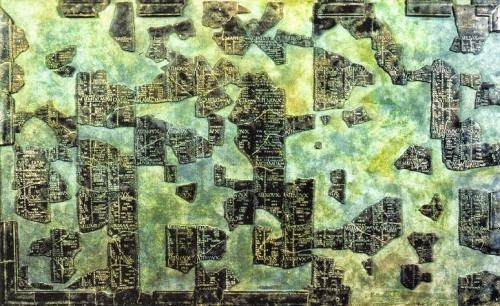
The Coligny Calendar was located in Coligny, Ain in France near Lyon in the year 1897 together with the head of a bronze statue of a young male figure.

It is a series of bronze tablets which dates to the first century BCE and is a record of the Gaulic year which shows certain Roman influence since Roman numerals have been used. From what is known of the Celtic year, the names of the month are in Gaulish where the year is presumed to begin in November resulting in debate on whether the year begins in November 1, May 1, December 21 or June 21.

The debate for November 1 is that Samonios is similar to the Irish Samhain, which falls on November 1 with a festival on the 17th of Samonia known as TRINVX SAMO SINDIV, the three nights of today's Samonia which reflects to the three days connected with the modern Samhain, Halloween, All Saint's Day and All Soul's Day which could be a coincidence.

The debate for May 1st is that samonios has come from samon, meaning summer which marks the beginning of the summer half of the year according to traditional Celtic lore and hence Samonios could be May 1st.

A LUNISOLAR CALENDAR


It is a lunisolar calendar, being both a lunar as well as a solar calendar, which has caused some issues with drifting. It was engraved on bronze tablet and preserved in 73 sections which originally were 1.48 m wide and 0.9 m high and judging on the style of lettering along with the accompanying objects, it could probably date back to the end of the 2nd century AD.

The writings here are in Latin inscriptional capitals in the Gaulish language and the restored tablet has sixteen vertical columns together with 62 months which are distributed over five years.

J. Monard, the French archaeologist thought that it could have been recorded by druid with the hope to preserve their tradition of timekeeping when the Julian calendar was imposed in the Roman Empire though the general form of the calendar indicate the public peg calendars which are found in Roman and Greek world.

CALENDAR FOLLOWED PATTERNS OF MOON AND STARS


Similar calendar was also found near Villards d'Heria which is only preserved in eight small section and is now kept in the Musee d'Archeologie du Jura at Lons-le-Saunier.The Coligny Calendar is also known as the Sequani Calendar and has been the subject of a lot of speculation.

This has given to rise to another group who have decided to take up the matter and speculate on it. Clay, an astronomer and Barbara Carter, and astrologer, Eadhmonn Ua Cuinn, a Celtic as well as a sculptor, Helen Benigni, a writer and mytologer, Mark Butervaugh, a naturalist and an artist, together with Tim Krantz, a printmaker formed a team to study this calendar. On studying the Calendar, the group discovered that it was even more accurate from the others that had been revealed so far.

They found that the calendar went by the patterns of the moon and stars and keeping track of the position of the constellation in the sky, the ancient Celts kept track of the time with accuracy. Clay and Barbara also discovered that each month was indicated by a star of first magnitude, marked as PRIN on the calendar which appeared on the Eastern Horizon after sunset and then setting on the Western Horizon at sunrise.

The stars travelling with the orbit of the moon indicated the time at night. Study on the legends and myths surrounding the stars and constellations helped the group to figure out how the Celts marked their planting times, harvest and holidays thus explaining their seasons.

Credit: magick-keys.blogspot.com