




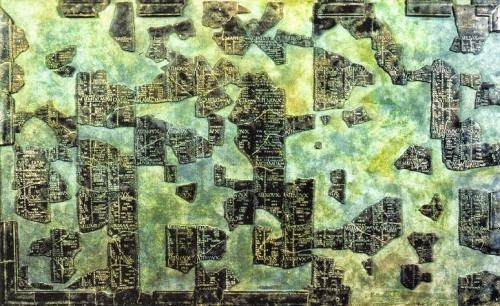
It is a series of bronze tablets which dates to the first century BCE and is a record of the Gaulic year which shows certain Roman influence since Roman numerals have been used. From what is known of the Celtic year, the names of the month are in Gaulish where the year is presumed to begin in November resulting in debate on whether the year begins in November 1, May 1, December 21 or June 21.
The debate for November 1 is that Samonios is similar to the Irish Samhain, which falls on November 1 with a festival on the 17th of Samonia known as TRINVX SAMO SINDIV, the three nights of today's Samonia which reflects to the three days connected with the modern Samhain, Halloween, All Saint's Day and All Soul's Day which could be a coincidence.
The debate for May 1st is that samonios has come from samon, meaning summer which marks the beginning of the summer half of the year according to traditional Celtic lore and hence Samonios could be May 1st.
A LUNISOLAR CALENDAR
It is a lunisolar calendar, being both a lunar as well as a solar calendar, which has caused some issues with drifting. It was engraved on bronze tablet and preserved in 73 sections which originally were 1.48 m wide and 0.9 m high and judging on the style of lettering along with the accompanying objects, it could probably date back to the end of the 2nd century AD.
The writings here are in Latin inscriptional capitals in the Gaulish language and the restored tablet has sixteen vertical columns together with 62 months which are distributed over five years.
J. Monard, the French archaeologist thought that it could have been recorded by druid with the hope to preserve their tradition of timekeeping when the Julian calendar was imposed in the Roman Empire though the general form of the calendar indicate the public peg calendars which are found in Roman and Greek world.
CALENDAR FOLLOWED PATTERNS OF MOON AND STARS
Similar calendar was also found near Villards d'Heria which is only preserved in eight small section and is now kept in the Musee d'Archeologie du Jura at Lons-le-Saunier.The Coligny Calendar is also known as the Sequani Calendar and has been the subject of a lot of speculation.
This has given to rise to another group who have decided to take up the matter and speculate on it. Clay, an astronomer and Barbara Carter, and astrologer, Eadhmonn Ua Cuinn, a Celtic as well as a sculptor, Helen Benigni, a writer and mytologer, Mark Butervaugh, a naturalist and an artist, together with Tim Krantz, a printmaker formed a team to study this calendar. On studying the Calendar, the group discovered that it was even more accurate from the others that had been revealed so far.
They found that the calendar went by the patterns of the moon and stars and keeping track of the position of the constellation in the sky, the ancient Celts kept track of the time with accuracy. Clay and Barbara also discovered that each month was indicated by a star of first magnitude, marked as PRIN on the calendar which appeared on the Eastern Horizon after sunset and then setting on the Western Horizon at sunrise.
The stars travelling with the orbit of the moon indicated the time at night. Study on the legends and myths surrounding the stars and constellations helped the group to figure out how the Celts marked their planting times, harvest and holidays thus explaining their seasons.
Credit: magick-keys.blogspot.com


