
Wicca is a modern pagan, witchcraft religion

Wicca is a diverse religion with no central authority or figure defining it.

Wicca often involves the ritual practice of magic, though it is not always necessary

Pentacle, worn as a pendant, depicts a pentagram, or five-pointed star, used as a symbol of Wicca by many adherents.

Beliefs in Wicca range from hard polytheism to even monotheism.

Wicca is typically duotheistic, worshipping a god and goddess traditionally viewed as a mother goddess and horned god.

The term Wicca first achieved widespread acceptance when referring to the religion in the 1960s and 70s

Application of the word Wicca has given rise to "a great deal of disagreement and infighting".

The Goddess and the God may be regarded as the Divine Feminine and the Divine Masculine

The God and Goddess are generally seen as lovers and equals, the Divine Couple who together co-create the cosmos.

Traditionally the God is viewed as a Horned God, associated with nature, wilderness, sexuality, hunting and the life cycle

The Horned God is given various names according to the tradition, and these include Cernunnos, Pan, Atho and Karnayna.

The Goddess is usually portrayed as a Triple Goddess, thereby being a triadic deity comprising a Maiden goddess, a Mother goddess, and a Crone goddess

Some Wiccans, particularly from the 1970s onwards, have viewed the Goddess as the more important of the two deities, who is pre-eminent in that she contains and conceives all. In this respect, the God is viewed as the spark of life and inspiration within her, simultaneously her lover and her child.

Friday, September 3, 2010

Werewolf

Werewolf
Whither Werewolf?

by Lilith Silverhair

"Even a man who's pure of heart
and says his prayers by night
May become a wolf when the wolfsbane blooms
and the Autumn Moon is bright."
- Curt Siodmak

Modern film makers and writers have done much to make the werewolf a pitiable creature. A man trapped by his own baser desires, unable to control the change or the urges that come upon him when the Moon shows Her full form each month.
But deep in our hazy past there was a time when the 'werwulf,' (spirit-wolf or man-wolf) was honored among our ancestors. The Wolf and those able to take her shape were worshipped as Goddesses and heroes.

Belief in shapeshifters was found throughout the range of the wolf's former habitats: from Europe and Asia as far east as India and China and throughout North America. What ties the legend if the werewolf together in all of these places is the fact that the wolf was the largest predator indigenous to those regions. The violence and aggression of were-beasts make this seem on the surface to be a hunting and warfare legend. True, it is this, but also much more.

Prehistoric peoples learned the ways of the hunt from the animals around them, and they learned the concept of time from watching the phases of the Moon. The Moon phases also concurred with the female menstrual cycles and so hunting, sex and time became totally enmeshed. The Full Moon was also the time in which the women of the tribe bled, in effect, canceling all sexual activity. The men's minds turned to the Hunt, knowing that sexual activity would resume after they had brought enough meat home to supplement the diet of grains and berries the women provided.

It is this circular reasoning that created the association of a female deity concerned with hunting, and in many cultures She was a Wolf. Apollo Lycaeus (Wolfish Apollo) was mated to Artemis as the "divine Wolf-bitch." The Sabine Goddess Feronia was "Mother of Wolves." Perhaps the most well-known of all was Diana, Mistress of the Hunt. Gaulish Diana under her totemic name Lupa, "She Wolf," was Mother of wild animals. Young men learned magic and shapeshifting from Her and She guided and protected them (provided, of course, that they never set foot inside a Christian Church.) Her follower's shapeshifting ability followed the Moon phases and the Moon was another form of the Goddess.

Shapeshifting abilities usually lay within the realm of one person in the tribe, the shaman. It was reasoned that at the moment of death, the animals that the hunters killed and/or emulated took themselves to the spiritual
"other-world." For the shamans to 'speak' to these animals, so that they could intervene on behalf of the humans, the shamans themselves must lose their own bodies and take on the aspects of the animals. And so the first shapeshifters were born.

Down through the years the werewolf was known in almost every culture. The title of the shaman who held high position in the life of the Slavs was
'volkhvi.' Variants are the German Volk, 'people' and the Russian Vrach,
'physician.' This indicates that the werewolves were people, shamanic healers in wolf masks.

It wasn't until Christianity came on the scene that the werewolf became the demonic creature that he is today. Christ was known as the Lamb of God and the enemy of the lamb is of course the wolf. The shift toward the imagery of the Lamb of Christ led in natural sequence to the wolf as satanic. The werewolf whose first meaning in biblical translations meant 'outlaw,' devolved from that into 'ravening wolf,' as in Matthew 7:15: "Beware of false prophets which come to you in sheep's clothing, but inwardly they are ravening wolves." Werewolves were captured and tortured by the Inquisition alongside accused Witches.

And so the werewolf descended throughout the centuries; from deity to demi-god, from shaman to satanic. The noble wolf, whose only crime was to howl at the Moon and teach awkward humans to hunt was demonized by those who would rather be led by a lamb than a true king or queen of beasts.

Sources:


The Beast Within: A History of the Werewolf. Adam Douglas - 1992

The Woman's Encyclopedia of Myths and Secrets. Barbara G. Walker - 1983

Thursday, September 2, 2010

Artemis Fowl And The Time Paradox By Eoin Colfer

Artemis Fowl And The Time Paradox By Eoin Colfer
Artemis Fowl and the Time Paradox is the sixth in this series of books about the young criminal mastermind and his adventures with the technologically advanced fairy people, who live below the Earth's surface. Except he's not criminal anymore! When we first met him in 2001(I think) he was a twelve year old criminal genius and he's now nearly eighteen, although due to time travelling escapades in his previous adventure, he only looks fourteen!

Artemis has been getting gradually more ethical and, (for want of a better word) nice throughout the series and in this book he discovers his mother is gravely ill, and that he caused it by using his ill gotten magical powers on her to mesmerise her into not questioning why he only looks fourteen. He calls for help from Captain Holly Short, his fairy friend, and comes to realise that the antidote to this fairy illness is only available from a certain type of lemur, which unfortunately, Artemis himself sold to an extinctionist group eight years ago to raise an obscene amount of money to rescue his father.

So cue more time travelling adventures as Artemis and Holly travel back in time to when Artemis was ten to rescue the lemur and save his mother. Being as Artemis knows when and where this exchange happens this should be a relatively simple job, but in true Artemis style it leads to a mad chase across continents pursuing the younger version of himself and managing to involve just about every fairy character ever to appear in these stories, all before they knew Artemis, of course.

The most interesting part of this story was the juxtaposition of Artemis then and Artemis now. The ten year old Artemis is very much the character we met in the first books of the series, obnoxious, cunning and devious, and the present day Artemis is shocked to realise exactly how obnoxious he was, and this realisation is pressed on him all the more firmly because to outwit his former self, he has to think like him.

This was a good read, and probably the best of this series since the first one. It had some lines that really made me chuckle, but unfortunately I can't quote them because I left the book with my Mum to read. And it had lots of surprises, including an inter species kiss between Artemis and Holly. I really didn't see that coming! Nor did I see the end coming, which without saying too much, ties the whole series up very nicely, but also leaves it open for more, depending I suppose on how Colfer feels. I do think it would be difficult to top this one though.

Credit: practicing-wicca.blogspot.com

Wednesday, September 1, 2010

Mormon Feminism Is Back

Mormon Feminism Is Back
From the Salt Basin Tribune:A new way of feminism seems to be unwrap across Mormonism.LDS women are flanked by on the Internet, exploring women's issues, debating theology and rupture their group joys and agonies in the arms of their male-run church. Happy-go-lucky about liable annoyance - and even pilot hints of collaboration in sermons - the faith's "slam better part" is reaching out to appreciate its stories in new ways and new seating to new audiences.A blatant British official statement, the Minder, published an paper this week by LDS blogger Tresa Edmunds, who unabashedly explained her cooperative nature as a Mormon and a feminist. Similarly this week, Newsweek featured Neylan McBaine, founder of a website that profiles sparkling and rare LDS women, examining the uncomfortable views of Mormon fatherhood.This summer, EXPONENT II, the decades-old quarterly for Mormon women that blocked printing in 2006, was reborn.

Origin: asatru-religion.blogspot.com

Sunday, August 29, 2010

Minor Schools Akademia Czarodziejstwa

Minor Schools Akademia Czarodziejstwa
"AKADEMIA CZARODZIEJSTWA Downright NAME:Akademia Czarodziejstwa w Krakowie (established as AC for minus)MOTTO:"Father ratio quam vis" (Dialogue mode above than power)FOUNDING:Akademia Czarodziejstwa w Krakowie was founded in 1399 fashionable Poland's golden age.LOCATION: Located in the under levels of "COLLEGIUM MAIUS" of the Jagiellonian Academy in Krakow, Akademia Czarodziejstwa was coeducational for example its beginning. To a great extent of the school lies underside the capital of Krak'ow. Due to it's founders helpful flair to the Sovereign of Poland and the Dignity Prince of Lithuania (ADVANCE LITHUANIAN COMPANY) offer is an wood causeway leading from the school to the dragon's den at Wawel Expansion (UNDERNEATHE THE DIGNITY SANCTUARY).Film OF AKADEMIA CZARODZIEJSTWA:Jagiellonian Academy was founded in 1364 by Sovereign Casimir the Very great (KAZIMIERZ WIELKI), making it Eastern Europe's luxury theoretical. In 1399, as soon as Sovereign Jadwiga donated her jewels to increase in intensity the Academy, Pawel Wlodkowic confident the nun of the theoretical to add on a magical unit to the school. Similar to the rector's meeting, Akademia Czarodziejstwa was further to amount an rebellious to Durmstrang and to further the working out of wizards, notoriously dwell in not of pureblood origin.Conscription was elfin until the 1800s.Every the students and aptitude participated in the Kosciuszko Riot of 1794. It's enter in the Kosciuszko Riot was to become the beginning of trend as AC became established for uprising during Poland's unstable history, straight earning the control "SEMINARY OF REBELS" and the Eastern European wizarding community.Akademia Czarodziejstwa was lawfully bunged from 1939-1945 due to the war with Grindelwald and the Nazi profession of Poland, its vice-rector and certified aptitude were murdered by Grindelwald. Despite this, the existing professors continued enlightening children in the under levels of the pubs of Krakow, highest of which were associated by secret passageways and provision at all aid it can to the protection.In pristine living, the Conference of AC has begun to mind the utility of moving AC to a above permament smidgen small from the Academy in Krakow.HOUSES:Houses are splintered up by sexual category. * Boys are housed in "DOM KAZIMIERZA" * Girls are housed in "DOM JADWIGI" * Academy AC students in "DOM PIAST'OW" (gendered floors)ALUMNI:Obvious Alumni: Nicholas Copernicus, Pawel Wlodkowic (promoter for muggleborn nationality in the 1400s)

"Gratitude to JAGIENKA for fleshing out AC and provision me with loads information that I was mighty to act match I knew above about Advance history than I really did."

Credit: asatru-religion.blogspot.com


Saturday, August 28, 2010

Mansnake

Mansnake
The Man and the Snake
by Ambrose Bierce

I


It is of veritabyll report, and attested of so many that there be
nowe of wyse and learned none to gaynsaye it, that ye serpente hys
eye hath a magnetick propertie that whosoe falleth into its svasion is drawn forwards in despyte of his wille, and perisheth miserabyll by ye creature hys byte.

Stretched at ease upon a sofa, in gown and slippers, Harker Brayton smiled as he read the foregoing sentence in old Morryster's
"Marvells of Science. The only marvel in the matter," he said to
himself, "is that the wise and learned in Morryster's day should
have believed such nonsense as is rejected by most of even the
ignorant in ours."

A train of reflections followed--for Brayton was a man of thought-- and he unconsciously lowered his book without altering the
direction of his eyes. As soon as the volume had gone below the
line of sight, something in an obscure corner of the room recalled
his attention to his surroundings. What he saw, in the shadow
under his bed, were two small points of light, apparently about an
inch apart. They might have been reflections of the gas jet above
him, in metal nail heads; he gave them but little thought and
resumed his reading. A moment later something--some impulse which
it did not occur to him to analyze--impelled him to lower the book
again and seek for what he saw before. The points of light were
still there. They seemed to have become brighter than before,
shining with a greenish luster which he had not at first observed.
He thought, too, that they might have moved a trifle--were somewhat nearer. They were still too much in the shadow, however, to reveal
their nature and origin to an indolent attention, and he resumed
his reading. Suddenly something in the text suggested a thought
which made him start and drop the book for the third time to the
side of the sofa, whence, escaping from his hand, it fell sprawling to the floor, back upward. Brayton, half-risen, was staring
intently into the obscurity beneath the bed, where the points of
light shone with, it seemed to him, an added fire. His attention
was now fully aroused, his gaze eager and imperative. It
disclosed, almost directly beneath the foot rail of the bed, the
coils of a large serpent--the points of light were its eyes! Its
horrible head, thrust flatly forth from the innermost coil and
resting upon the outermost, was directed straight toward him, the
definition of the wide, brutal jaw and the idiotlike forehead
serving to show the direction of its malevolent gaze. The eyes
were no longer merely luminous points; they looked into his own
with a meaning, a malign significance.

II


A snake in a bedroom of a modern city dwelling of the better sort
is, happily, not so common a phenomenon as to make explanation
altogether needless. Harker Brayton, a bachelor of thirty-five, a
scholar, idler, and something of an athlete, rich, popular, and of
sound health, had returned to San Francisco from all manner of
remote and unfamiliar countries. His tastes, always a trifle
luxurious, had taken on an added exuberance from long privation;
and the resources of even the Castle Hotel being inadequate for
their perfect gratification, he had gladly accepted the hospitality of his friend, Dr. Druring, the distinguished scientist. Dr.
Druring's house, a large, old-fashioned one in what was now an
obscure quarter of the city, had an outer and visible aspect of
reserve. It plainly would not associate with the contiguous
elements of its altered environment, and appeared to have developed some of the eccentricities which come of isolation. One of these
was a "wing," conspicuously irrelevant in point of architecture,
and no less rebellious in the matter of purpose; for it was a
combination of laboratory, menagerie, and museum. It was here that
the doctor indulged the scientific side of his nature in the study
of such forms of animal life as engaged his interest and comforted
his taste--which, it must be confessed, ran rather to the lower
forms. For one of the higher types nimbly and sweetly to recommend
itself unto his gentle senses, it had at least to retain certain
rudimentary characteristics allying it to such "dragons of the
prime
" as toads and snakes. His scientific sympathies were
distinctly reptilian; he loved nature's vulgarians and described
himself as the Zola of zoology. His wife and daughters, not having
the advantage to share his enlightened curiosity regarding the
works and ways of our ill-starred fellow-creatures, were, with
needless austerity, excluded from what he called the Snakery, and
doomed to companionship with their own kind; though, to soften the
rigors of their lot, he had permitted them, out of his great
wealth, to outdo the reptiles in the gorgeousness of their
surroundings and to shine with a superior splendor.

Architecturally, and in point of "furnishing," the Snakery had a
severe simplicity befitting the humble circumstances of its
occupants, many of whom, indeed, could not safely have been
intrusted with the liberty which is necessary to the full enjoyment of luxury, for they had the troublesome peculiarity of being alive.
In their own apartments, however, they were under as little
personal restraint as was compatible with their protection from the baneful habit of swallowing one another; and, as Brayton had
thoughtfully been apprised, it was more than a tradition that some
of them had at divers times been found in parts of the premises
where it would have embarrassed them to explain their presence.
Despite the Snakery and its uncanny associations--to which, indeed, he gave little attention--Brayton found life at the Druring mansion very much to his mind.

III


Beyond a smart shock of surprise and a shudder of mere loathing,
Mr. Brayton was not greatly affected. His first thought was to
ring the call bell and bring a servant; but, although the bell cord dangled within easy reach, he made no movement toward it; it had
occurred to his mind that the act might subject him to the
suspicion of fear, which he certainly did not feel. He was more
keenly conscious of the incongruous nature of the situation than
affected by its perils; it was revolting, but absurd.

The reptile was of a species with which Brayton was unfamiliar.
Its length he could only conjecture; the body at the largest
visible part seemed about as thick as his forearm. In what way was
it dangerous, if in any way? Was it venomous? Was it a
constrictor? His knowledge of nature's danger signals did not
enable him to say; he had never deciphered the code.

If not dangerous, the creature was at least offensive. It was de
trop--"matter out of place"--an impertinence. The gem was unworthy
of the setting. Even the barbarous taste of our time and country,
which had loaded the walls of the room with pictures, the floor
with furniture, and the furniture with bric-a-brac, had not quite
fitted the place for this bit of the savage life of the jungle.
Besides--insupportable thought!--the exhalations of its breath
mingled with the atmosphere which he himself was breathing!

These thoughts shaped themselves with greater or less definition in Brayton's mind, and begot action. The process is what we call
consideration and decision. It is thus that we are wise and
unwise. It is thus that the withered leaf in an autumn breeze
shows greater or less intelligence than its fellows, falling upon
the land or upon the lake. The secret of human action is an open
one--something contracts our muscles. Does it matter if we give to
the preparatory molecular changes the name of will?

Brayton rose to his feet and prepared to back softly away from the
snake, without disturbing it, if possible, and through the door.
People retire so from the presence of the great, for greatness is
power, and power is a menace. He knew that he could walk backward
without obstruction, and find the door without error. Should the
monster follow, the taste which had plastered the walls with
paintings had consistently supplied a rack of murderous Oriental
weapons from which he could snatch one to suit the occasion. In
the meantime the snake's eyes burned with a more pitiless
malevolence than ever.

Brayton lifted his right foot free of the floor to step backward.
That moment he felt a strong aversion to doing so.

"I am accounted brave," he murmured; "is bravery, then, no more
than pride? Because there are none to witness the shame shall I
retreat?"

He was steadying himself with his right hand upon the back of a
chair, his foot suspended.

"Nonsense!" he said aloud; "I am not so great a coward as to fear
to seem to myself afraid."

He lifted the foot a little higher by slightly bending the knee,
and thrust it sharply to the floor--an inch in front of the other!
He could not think how that occurred. A trial with the left foot
had the same result; it was again in advance of the right. The
hand upon the chair back was grasping it; the arm was straight,
reaching somewhat backward. One might have seen that he was
reluctant to lose his hold. The snake's malignant head was still
thrust forth from the inner coil as before, the neck level. It had
not moved, but its eyes were now electric sparks, radiating an
infinity of luminous needles.

The man had an ashy pallor. Again he took a step forward, and
another, partly dragging the chair, which, when finally released,
fell upon the floor with a crash. The man groaned; the snake made
neither sound nor motion, but its eyes were two dazzling suns. The
reptile itself was wholly concealed by them. They gave off
enlarging rings of rich and vivid colors, which at their greatest
expansion successively vanished like soap bubbles; they seemed to
approach his very face, and anon were an immeasurable distance
away. He heard, somewhere, the continual throbbing of a great
drum, with desultory bursts of far music, inconceivably sweet, like the tones of an aeolian harp. He knew it for the sunrise melody of
Memnon's statue, and thought he stood in the Nileside reeds,
hearing, with exalted sense, that immortal anthem through the
silence of the centuries.

The music ceased; rather, it became by insensible degrees the
distant roll of a retreating thunderstorm. A landscape, glittering
with sun and rain, stretched before him, arched with a vivid
rainbow, framing in its giant curve a hundred visible cities. In
the middle distance a vast serpent, wearing a crown, reared its
head out of its voluminous convolutions and looked at him with his
dead mother's eyes. Suddenly this enchanting landscape seemed to
rise swiftly upward, like the drop scene at a theater, and vanished in a blank. Something struck him a hard blow upon the face and
breast. He had fallen to the floor; the blood ran from his broken
nose and his bruised lips. For a moment he was dazed and stunned,
and lay with closed eyes, his face against the door. In a few
moments he had recovered, and then realized that his fall, by
withdrawing his eyes, had broken the spell which held him. He felt
that now, by keeping his gaze averted, he would be able to retreat.
But the thought of the serpent within a few feet of his head, yet
unseen--perhaps in the very act of springing upon him and throwing
its coils about his throat--was too horrible. He lifted his head,
stared again into those baleful eyes, and was again in bondage.

The snake had not moved, and appeared somewhat to have lost its
power upon the imagination; the gorgeous illusions of a few moments before were not repeated. Beneath that flat and brainless brow its
black, beady eyes simply glittered, as at first, with an expression unspeakably malignant. It was as if the creature, knowing its
triumph assured, had determined to practice no more alluring wiles.

Now ensued a fearful scene. The man, prone upon the floor, within
a yard of his enemy, raised the upper part of his body upon his
elbows, his head thrown back, his legs extended to their full
length. His face was white between its gouts of blood; his eyes
were strained open to their uttermost expansion. There was froth
upon his lips; it dropped off in flakes. Strong convulsions ran
through his body, making almost serpentine undulations. He bent
himself at the waist, shifting his legs from side to side. And
every movement left him a little nearer to the snake. He thrust
his hands forward to brace himself back, yet constantly advanced
upon his elbows.

IV


Dr. Druring and his wife sat in the library. The scientist was in
rare good humor.

"I have just obtained, by exchange with another collector," he
said, "a splendid specimen of the Ophiophagus."

"And what may that be?" the lady inquired with a somewhat languid
interest.

"Why, bless my soul, what profound ignorance! My dear, a man who
ascertains after marriage that his wife does not know Greek, is
entitled to a divorce. The Ophiophagus is a snake which eats other
snakes."

"I hope it will eat all yours," she said, absently shifting the
lamp. "But how does it get the other snakes? By charming them, I
suppose."

"That is just like you, dear," said the doctor, with an affectation of petulance. "You know how irritating to me is any allusion to
that vulgar superstition about the snake's power of fascination."

The conversation was interrupted by a mighty cry which rang through the silent house like the voice of a demon shouting in a tomb.
Again and yet again it sounded, with terrible distinctness. They
sprang to their feet, the man confused, the lady pale and
speechless with fright. Almost before the echoes of the last cry
had died away the doctor was out of the room, springing up the
staircase two steps at a time. In the corridor, in front of
Brayton's chamber, he met some servants who had come from the upper floor. Together they rushed at the door without knocking. It was
unfastened, and gave way. Brayton lay upon his stomach on the
floor, dead. His head and arms were partly concealed under the
foot rail of the bed. They pulled the body away, turning it upon
the back. The face was daubed with blood and froth, the eyes were
wide open, staring--a dreadful sight!

"Died in a fit," said the scientist, bending his knee and placing
his hand upon the heart. While in that position he happened to
glance under the bed. "Good God!" he added; "how did this thing
get in here?"

He reached under the bed, pulled out the snake, and flung it, still coiled, to the center of the room, whence, with a harsh, shuffling
sound, it slid across the polished floor till stopped by the wall,
where it lay without motion. It was a stuffed snake; its eyes were
two shoe buttons.

Thursday, August 26, 2010

Samhain Ceremony To Honor The Spirits Of Animals

Samhain Ceremony To Honor The Spirits Of Animals
THIS CEREMONY IS DESIGNED TO HONOR THE SPIRITS OF THE ANIMALS - BOTH WILD AND DOMESTIC. MAN'S RELATIONSHIP WITH ANIMALS GOES BACK THOUSANDS AND THOUSANDS OF YEARS. THEY HAVE BEEN A SOURCE OF FOOD AND CLOTHING. THEY HAVE PROTECTED US FROM THE THINGS THAT LURK IN THE DARKNESS. THEY HAVE PROVIDED COMFORT AND WARMTH. IN SOME CASES, THEY HAVE EVEN RAISED AND NURTURED OUR DISCARDED CHILDREN, AS IN THE CASE OF ROMULUS AND REMUS. IF YOU HAVE ANIMALS IN YOUR HOME -- PETS OR LIVESTOCK -- THIS IS THEIR NIGHT. FEED THEM BEFORE YOU FEED THE HUMANS IN YOUR FAMILY. PUT SOME FOOD OUT FOR ANY WILD ANIMALS THAT MAY HAPPEN BY AS WELL. HERE'S HOW: * IF YOU HAVE A PET THAT HAS PASSED AWAY DURING THIS LAST YEAR, YOU MAY WANT TO INCLUDE A PHOTO OR KEEPSAKE OF THEM ON YOUR TABLE DURING THIS RITE. PREPARE A STEW FOR YOUR FAMILY THAT INCLUDES SMALL AMOUNTS OF AS MANY DIFFERENT MEATS AS YOU MAY HAVE AVAILABLE -- BEEF, PORK, GAME, CHICKEN, ETC. IF YOUR FAMILY IS VEGETARIAN OR VEGAN, DESIGNATE A NON-MEAT INGREDIENT TO REPRESENT EACH ANIMAL AND ADAPT THE RITUAL AS NEEDED, ELIMINATING LINES THAT REFERENCE THE EATING OF ANIMALS. WHEN YOUR STEW IS READY, GATHER THE FAMILY AROUND THE ALTAR TABLE YOU PREPARED DURING THE PREVIOUS NIGHT'S HARVEST END RITUAL. * PLACE THE STEW POT IN THE CENTER OF THE TABLE, WITH A LARGE SERVING SPOON OR LADLE. MAKE SURE YOU HAVE SOME GOOD DARK BREAD TO EAT AS WELL. EACH MEMBER OF THE FAMILY SHOULD HAVE A BOWL AND SPOON HANDY. SAY:Samhain has come, and it is the end of the Harvest. The crops are in from the fields, And the animals are preparing for the coming winter. Tonight, we honor the animals in our lives. Some have died that we may eat. Some have provided us with love. Some have protected us from that which would do us harm. Tonight, we thank them all. * GO AROUND THE FAMILY IN A CIRCLE. EACH PERSON SHOULD TAKE A SCOOP OF STEW FROM THE POT AND PLACE IT IN THEIR BOWL. YOUNGER CHILDREN MAY NEED AN ADULT'S HELP WITH THIS. AS EACH PERSON GETS THEIR HELPING, SAY:Blessed are the animals, Those who die that we may eat. Blessed are the animals, Those we love and who love us in return. WHEN EVERY FAMILY MEMBER HAS THEIR STEW, EACH TAKES A PIECE OF BREAD. AS THEY DO, SAY:As the Wheel of the Year continues to turn, The harvest has ended, and the grain has been threshed. The animals sleep for the winter. We thank them for their gifts. * TAKE YOUR TIME FINISHING YOUR MEAL. IF YOU HAVE PETS, DON'T BE SURPRISED IF THEY COME VISIT WHILE YOU'RE EATING YOUR STEW TONIGHT -- ANIMALS TEND TO BE VERY AWARE OF THE SPIRITUAL PLANE! IF THERE IS ANY STEW LEFT OVER, LEAVE SOME OUT FOR THE SPIRITS. ANY EXTRA BREAD CAN BE THROWN OUTSIDE FOR THE WILD ANIMALS AND BIRDS.TIPS: * IF YOU WANT TO MIX A BIT OF STEW IN WITH YOUR PET'S EVERYDAY FOOD, IT'S A GOOD IDEA TO CHECK WITH YOUR VETERINARIAN FIRST. WHAT YOU NEED: * AN ALTAR TABLE * A POT OF STEW * SOME HEARTY DARK BREAD

Sunday, August 22, 2010

What The Buddhist Saint Said To The King Poson

What The Buddhist Saint Said To The King Poson
Dhr. Seven and Amber Larson, WISDOM QUARTERLY translation, Dharma Vijaya Vihara ("Cula-hatthipadopama Sutta": Shorter Elephant Footprint Simile, MN 27)

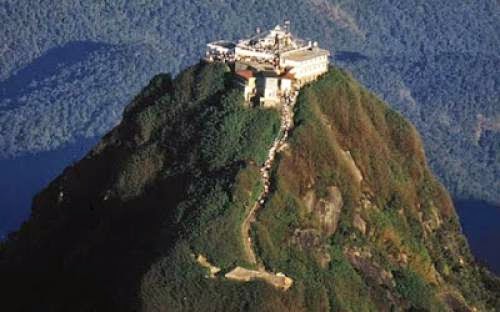
Adam's Peak, the highest point on the Buddhist island of Sri Lanka (hellotravel.com)

Mahintale (hellotravel.com)

PART 1: The Buddhist saint (arhat, fully enlightened) MAHINDA, son of Emperor Asoka of India, ventured with his saint sister Sanghamitta to the island of Lanka. There he met the king and delivered a discourse based on The Shorter Elephant Footprint Simile. So moved was the king that he and the people of the island converted to Buddhism. This took place on POSON more than 2,000 years ago, the full moon observance day in June.

Thus have I heard. Once the Blessed One was staying near Savatthi at Jeta's Grove in Anathapindika's abbey.

Now at that time, the Brahmin Janussonin was driving out of Savatthi in the middle of the day in a white chariot. He saw Pilotika the wanderer coming from afar and on meeting him said:

"Now where is Master Vacchayana [his clan name] coming from in the middle of the day? Sir, I have come here from the presence of the recluse (WANDERING ASCETIC) Gotama [Siddhartha Gautama, the Buddha]. And what does a wise person think about the recluse Gotama's wisdom? Sir, who am I to know the recluse Gotama's wisdom? Wouldn't one have to be his equal to know his wisdom? Master Vacchayana praises the recluse Gotama lavishly indeed!"

"

Visiting a modern wonder - Lions's Rock, Sigiriya (NH53/flickr.com)

"Sir, who am I to praise the recluse Gotama? He is praised by the praised as the best of beings, both human and deva". Seeing what reasons does Master Vacchayana have such high confidence in the recluse Gotama? Sir, suppose an elephant tracker were to enter an elephant forest and see there a large footprint, long in extent, broad in width. That tracker would come to the conclusion, 'What a big bull elephant!'

"In the same way, when I saw four footprints of the recluse Gotama, I came to the conclusion: 'The Blessed One is truly awakened, the Dharma is well-taught by the Blessed One, the "Sangha "of the Blessed One's disciples is practicing in a good way.' What are the four?

Lion's Rock fort, SIGIRIYA, a former Buddhist hermitage (hellotravel.com)

"In one case I see noble warriors (KSHATRIYAS) who are pundits, subtle, skilled in debate, like hair-splitting marksmen. They prowl about, as it were, shooting philosophical positions to pieces with their dialectic. They hear:

"'The recluse Gotama, they say, will visit that village or town.' They formulate a question like, 'Having gone to the recluse Gotama, we will ask him this question of ours. If, having been asked like this, he answers like that, we will refute his teaching this way. If having been asked like that, he answers like this, we will refute his teaching this other way.'

"They hear, 'the recluse Gotama is visiting such and such village or town.' They go to him, and he instructs, urges, rouses, and encourages them with a talk on Dharma. Having been instructed, urged, roused, and encouraged by him with a talk on Dharma, they do not even ask him their question, so how could they refute him? As it turns out, they become his disciples.

"When I saw this first footprint in the recluse Gotama, I came to this conclusion: 'The Blessed One is fully self-awakened; the Dharma is well-taught by the Blessed One; the "Sangha" of the Blessed One's disciples is practicing in a good way.'

FOOTPRINTS


I. FIRST FOOTPRINT: Clever, learned Brahmins visit the Buddha with the intention of refuting his Dharma (Teaching). But after they have been instructed, urged, roused, and encouraged they do not ask questions. They ask to become disciples.

II. SECOND FOOTPRINT: Clever, learned householders (laypersons) visit the Buddha, are instructed, have no more questions, and ask to become disciples.

III. THIRD FOOTPRINT: Clever, learned householders visit the Buddha and end up asking to become disciples.

IV. FOURTH FOOTPRINT: Clever, learned Brahmins go see the Buddha, end up having no more questions and instead ask to becomes disciples, the not long after -- by realizing the Dharma for themselves -- they become arhats (enlightened/liberated beings).

The Brahmin Janussoni then went to visit the Blessed One. With regard to the elephant's footprint, the Buddha told him that a wise person would follow the footprints and other markings left by the elephant until actually seeing that it was a big bull elephant.

What are the footprints of an intrepid Wayfarer (Tathagata) like the Buddha? The first footprint of the Tathagata is... CONTINUED IN PART II