
Wicca is a modern pagan, witchcraft religion

Wicca is a diverse religion with no central authority or figure defining it.

Wicca often involves the ritual practice of magic, though it is not always necessary

Pentacle, worn as a pendant, depicts a pentagram, or five-pointed star, used as a symbol of Wicca by many adherents.

Beliefs in Wicca range from hard polytheism to even monotheism.

Wicca is typically duotheistic, worshipping a god and goddess traditionally viewed as a mother goddess and horned god.

The term Wicca first achieved widespread acceptance when referring to the religion in the 1960s and 70s

Application of the word Wicca has given rise to "a great deal of disagreement and infighting".

The Goddess and the God may be regarded as the Divine Feminine and the Divine Masculine

The God and Goddess are generally seen as lovers and equals, the Divine Couple who together co-create the cosmos.

Traditionally the God is viewed as a Horned God, associated with nature, wilderness, sexuality, hunting and the life cycle

The Horned God is given various names according to the tradition, and these include Cernunnos, Pan, Atho and Karnayna.

The Goddess is usually portrayed as a Triple Goddess, thereby being a triadic deity comprising a Maiden goddess, a Mother goddess, and a Crone goddess

Some Wiccans, particularly from the 1970s onwards, have viewed the Goddess as the more important of the two deities, who is pre-eminent in that she contains and conceives all. In this respect, the God is viewed as the spark of life and inspiration within her, simultaneously her lover and her child.

Showing posts with label baptism. Show all posts

Tuesday, April 29, 2014

Is There Wiggle Room For Head Coverings And Baptism

Is There Wiggle Room For Head Coverings And Baptism
I recently spent 10 days with a group of evangelical missionaries on my medical mission to Haiti. One day, the topic of baptism came up. There was at least 6 differing opinions regarding the significance and meaning of baptism from the different folks who contributed to the conversation. Even more interesting, yet sad, was that these folks were from the same church and yet did not hold to the the same uniform doctrine regarding baptism.

At one point I asked if anyone thought that baptism was necessary for salvation? Interesting that now they were all in agreement that baptism had nothing to do with salvation! So despite the disparate views of baptism, an act of obedience, a sign of an inward work, etc, all agreed that it had no bearing on salvation. The discussion then lead to comments about Catholics baptizing dead babies and weird rituals that someone's Catholic grandma had told them about. I declined to put my two cents in at this point seeing the "cath bash" commence.

Christ promised to send us the Holy Spirit to lead us in all truth. Did He really grant that we could/should develop our own disparate views of important Christian doctrines? Particularly something as important as baptism? Did Jesus really truly think it would be acceptable to hold complete opposite views regarding key theological constructs? The first 1500 years of Christianity held essentially one view of the meaning and purpose of baptism. Not until the casting off of sacramental theology did we see baptism become symbolic. Or, did the early Church fathers get this doctrine wrong as it was passed on from the apostles? It then took over 1500 years for the Holy Spirit to finally crack the hard heart of man to be open to God's truth and return us to the correct interpretation?

I once asked a pastor how I should decide what to believe regarding essential doctrines. He instructed me to get 3 or 4 good Scripture commentaries and prayerfully pick one that I agree with the most. I am sorry, but I can't see that as being what Christ intended as a method of finding Truth regarding an essential doctrine. What if Christ really intended us to be born again through the waters of baptism but we insisted that it was just a symbolic act of obedience? Wouldn't that be an awfully big mistake to make? What if when Peter said "the waters of baptism doth save you," he really meant it literally and not just symbolically?

This is not a non-essential concept that we can just pray about and choose what we believe! We are talking about salvation here and I don't think there should be a particularly large amount of wiggle room, as if we were discussing whether women should wear head coverings in Church.(no offense ladies) If the Bible was intended to be our "go to" book to solve all doctrinal disagreements, why doesn't it seem to work out that way in practice?

Jesus, By your Holy Spirit, lead us in All Truth.


Reference: wizard-notes.blogspot.com
Tuesday, March 8, 2011

The Early Church And Baptism

The Early Church And Baptism
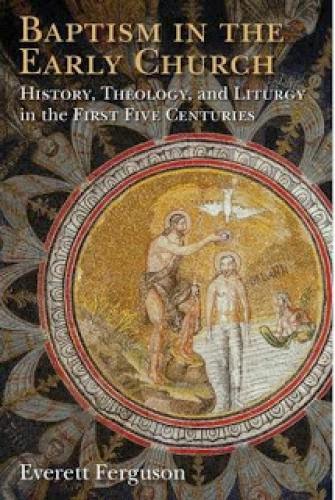
At Between Two Worlds, Justin Taylor calls attention to a new book about "Baptism in the Early Church: History, Theology, and Liturgy in the First Five Centuries" by Everett Ferguson. Taylor quotes from Ferguson's conclusions:"On infant baptism", he writes:There is general agreement that there is no firm evidence for infant baptism before the latter part of the second century. This fact does not mean that it did not occur, but it does mean that supporters of the practice have a considerable chronological gap to account for. Many replace the historical silence by appeal to theological or sociological considerations....

The most plausible explanation for the origin of infant baptism is found in the emergency baptism of sick children expected to die soon so that they would be assured of entrance into the kingdom of heaven. There was a slow extension of baptizing babies as a precautionary measure. It was generally accepted, but questions continued to be raised about its propriety into the fifth century. It became the usual practice in the fifth and sixth centuries. (pp. 856, 857)On the "mode of baptism", he writes:The comprehensive survey of the evidence compiled in this study give a basis for a fresh look at this subject and seeks to give coherence to that evidence while addressing seeming anomalies. The Christian literary sources, backed by secular word usage and Jewish religious immersions, give an overwhelming support for full immersion as the normal action. Exceptions in cases of a lack of water and especially of sickbed baptism were made.

Submersion was undoubtedly the case for the fourth and fifth centuries in the Greek East and only slightly less certain for the Latin West. Was this a change from an earlier practice, a selection out of options previously available, or a continuation of the practice of the first three centuries? It is the contention of this study that the last interpretation best accords with the available facts. Unless one has preconceived ideas about how an immersion would be performed, the literary, art, and archaeological evidence supports this conclusion. (p. 857)There are some interesting comments at Taylor's site.

[Note: I am a Baptist who believes that a similar evolution happened with the shift of Christian worship from the seventh day to the first, and that the Scriptural authority for that change is at least as feeble as that for infant baptism. It would be great to have a genuinely objective and scholarly examination of that question. Almost everything I've seen addressing the issue has been polemical. I realize that not all Christian traditions view Scripture as the sole authority for their practices, but that "is "supposed to be a fundamental principle for Protestants. (To preclude any misunderstanding - Seventh Day Baptists are not among those who believe that seventh-day Sabbath keeping is the mark of any kind of special status.)]

Between Two Worlds: Ferguson on Infant Baptism and the Mode of Baptism