
Wicca is a modern pagan, witchcraft religion

Wicca is a diverse religion with no central authority or figure defining it.

Wicca often involves the ritual practice of magic, though it is not always necessary

Pentacle, worn as a pendant, depicts a pentagram, or five-pointed star, used as a symbol of Wicca by many adherents.

Beliefs in Wicca range from hard polytheism to even monotheism.

Wicca is typically duotheistic, worshipping a god and goddess traditionally viewed as a mother goddess and horned god.

The term Wicca first achieved widespread acceptance when referring to the religion in the 1960s and 70s

Application of the word Wicca has given rise to "a great deal of disagreement and infighting".

The Goddess and the God may be regarded as the Divine Feminine and the Divine Masculine

The God and Goddess are generally seen as lovers and equals, the Divine Couple who together co-create the cosmos.

Traditionally the God is viewed as a Horned God, associated with nature, wilderness, sexuality, hunting and the life cycle

The Horned God is given various names according to the tradition, and these include Cernunnos, Pan, Atho and Karnayna.

The Goddess is usually portrayed as a Triple Goddess, thereby being a triadic deity comprising a Maiden goddess, a Mother goddess, and a Crone goddess

Some Wiccans, particularly from the 1970s onwards, have viewed the Goddess as the more important of the two deities, who is pre-eminent in that she contains and conceives all. In this respect, the God is viewed as the spark of life and inspiration within her, simultaneously her lover and her child.

Thursday, January 15, 2015

Money Voodoo Doll

Money Voodoo Doll
Are you tired of living paycheck to paycheck ? Are your bills piling up? Are you overwhelmed with the

stress of not having enough money? Are you down on your luck? Stop waiting for the day to come and make it happen now, take control

of your destiny! Let this powerful Voodoo Doll do the work for you so you can have the money you deserve.

HOW CAN THE MONEY VOODOO DOLL HELP YOU?

* "USE THIS POWERFUL VOODOO DOLL WATCH AND WATCH AS YOUR INCOME GOES UP WHILE YOUR BILLS AND DEBTS SEEM TO MELT AWAY."
* Be the lucky one that everyone says wins everything!
* "INCREASE YOUR CHANCE OF WINNING THE BIG ONE IN THE LOTTERY!"
* "GET READY FOR A HUGE FINANCIAL CHANGE IN YOUR LIFE..."
* "EXPECT TO SOON BE IN A BETTER HOME, CAR, AND LIFESTYLE!"

Its time for you take control of your own life and destiny and have financial freedom today!

After ordering your doll, I will contact you through email for information to personalize the spell exactly for you. The Money Voodoo Doll is handmade by me and the spell is put into the doll, once, twice, or even up to three times if you choose the most powerful of spells. After the spell is cast you will receive your package which includes the Voodoo Doll with the magic embodied inside along with instructions.

RESERVE YOURS NOW...

Casting Level


Single Cast 59.99 USD

Double Cast 99.99 USD

Triple Cast 139.99 USD

One Night Fast Cast 179.99 USD


Source: crafty-witch.blogspot.com
Wednesday, January 14, 2015

Religion And Spirituality Open Question Why The Tibetan Buddhism Does Not Belong To Buddhism

Religion And Spirituality Open Question Why The Tibetan Buddhism Does Not Belong To Buddhism
Before Buddhism was brought to Tibet, the Tibetans had their believes in "Bon". "Bon" is a kind of folk beliefs which gives offerings to ghosts and gods and receives their blessing. It belongs to local folk beliefs.In the Chinese Tang Dynasty, the Tibetan King Songts"an Gampo brought "Buddhism" to the Tibetan people which became the state religion. The so-called "Buddhism" is Tantric Buddhism which spreads out during the final period of Indian Buddhism. The Tantric Buddhism is also named "left hand tantra" because of its tantric sexual practices. In order to suit Tibetan manners and customs, the tantric Buddhism was mixed with "Bon". Due to its beliefs of ghosts and sexual practices, it became more excessive.The tantric Master Ati'sa spread out the tantric sex teachings in private. Padmasambhava taught it in public, so that the Tibetan Buddhism stands not only apart from Buddhist teachings, but also from Buddhist form. Thus, the Tibetan Buddhism does not belong to Buddhism, and has to be renamed "Lamaism".Read More:http://www.xzmzjiemi.com/en/

Religion Belief Going Dutch

Religion Belief Going Dutch
"GREETINGS, SISTER!"

"I HAVE A SAINT-MATCHING REQUEST."

"I RECENTLY MOVED TO THE DUTCH SPEAKING PART OF BELGIUM BUT I DON'T SPEAK ANY DUTCH! LEARNING FOREIGN LANGUAGES DOESN'T COME EASILY TO ME."

"CAN YOU RECOMMEND A SAINT FOR ME FOR EITHER LANGUAGE LEARNING IN GENERAL AND/OR DUTCH IN PARTICULAR?"

"MANY THANKS FOR ANY HELP!"

Oh, you poor thing! I suppose some people have a penchant for languages. I am not one of them. I speak English and few badly pronounced words of French. Numbers one through ten in Spanish. Miro! Look!

As a result, I am forever baffled by people who are hard on immigrants in the States for not learning English. To me, that is like being aggravated with someone for not knowing how to fix a car. It would be nice to know, but it's just not that easy.

There have already been a couple of very good suggestions in the comments section, but I'm going to go with:

THE TWELVE APOSTLES!

And here we are just after Pentecost! You" do" remember Pentecost? The disciples got together in a room and the Holy Spirit descended on them and voila! (French for "There!"), they could speak and be heard in any language. I'm sure Dutch would have been in there if there was a Dutch language at that time.

Wouldn't that be great? The Holy Spirit descends on you and you can speak Dutch? How 'bout it? Since it sounds like you need as much help as I would, I decided to go with all twelve, although you could conceivably focus on someone like St. Thomas, who maybe was the only apostle to leave the Roman Empire. He went to India (maybe) and would have had to use his new gifts.

The patron saint of Belgium is St. Alena. Such a pretty name! She was the daughter of a chieftain and her night time disappearing act worried her father. He had her followed. She was going to a chapel. He decided she had been bewitched by the Christians and had her dragged home. A fight ensued where her arm was cut or torn off. An angel swooped in and grabbed the arm and flew it over to the chapel, placing it on the altar. Having seen an angel fly in and fly off with the arm, caused Alena's parents to reconsider their attitude toward Christians and they both converted. Being a saint, Alena didn't seem to care about her missing arm. Although, technically it wasn't missing. Everyone knew right where it was. Here she is in Heaven with her arm back. I think.

Credit: goddesses-and-gods.blogspot.com

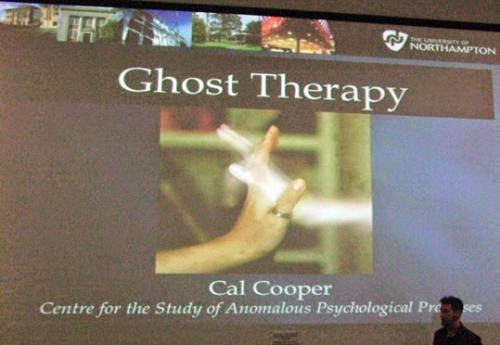
Death Cal Cooper On Ghost Therapy

Death Cal Cooper On Ghost Therapy
I frequently talked to my mother in the days and months after she died. Sometimes I still do. I could feel her presence in her favourite armchair and wouldn't let other people sit there. Even now, I only let the cat sleep on that chair, which remains where it was when she was alive, by the window my mum liked to look out of and watch the world go by.

If I close my eyes and try to tune in to the realm of the spirits, I can sometimes hear her voice offering advice or just making a wry comment as she often would in life. Do you think that makes me weird? I used to think so, but after listening to Cal Cooper talk about ghost therapy at Goldsmith's Anomalistic Psychology Research Unit on Tuesday evening I realised I am far from alone. However, apparently few people readily admit they have been chatting with dead relatives because they are also worried others will think them weird.

Cal Cooper is doing a PhD at the University of Northampton, lectures on parapsychology and is the author of the book Telephone Calls from the Dead.His talk was about post-death experiences in the bereaved - meaning people seeing, hearing or otherwise sensing a loved one after they had died - and how these experiences can help them get over their grief.

A study by WD Rees in 1971 showed it was extremely common for people to sense the presence of a dead spouse or relative - perhaps seeing them and having conversations with them or just feeling they were close or dreaming about them. What's more, 85% of those people found the experience helpful. Very few were scared - despite ghosts normally being considered pretty scary things.

Later research showed that most apparitions of that kind occurred 24 hours before or after the death, with the peak time being at the moment of death. It can happen for months or even years afterwards though. It is a common practice for the window in the room of a dying person to be left open so that the spirit can leave and many nurses have reported seeing a mist passing out of a dead person.

Although most of those kinds of experiences are unexpected, other contact with dead loved ones is sought out - such as going to seances. Cal asked whether seances are a bad thing if those going to them feel that they help them. Obviously there is a problem if a medium charges large amounts of money from someone who can ill afford it, but if the seance is free and those who attend feel helped, what is the problem?

Most people who go to mediums are generally positive about the experience and it can be considered a form of counselling. It can strengthen a belief in the afterlife and give a sense of peace and comfort. Cal believes that any counsellor who has a bereaved person as a client could help them by listening to any spiritual stories they tell - such as seeing the ghost of a loved one - and "putting themselves in their shoes".

Most of the stories the bereaved relate about connectivity with the dead are helpful. The main positive thing that seems to come from them is a sense of hope - and, like Pandora's Box, hope is a very important thing to retain when you feel you have lost everything.

I thought the topic of ghost therapy and contact with the dead being helpful for the bereaved was particularly relevant at Samhain - or Halloween - when many pagans like to honour dead ancestors and sometimes try to contact them through seances or other rites or ceremonies. As Cal observed, ghosts need not be scary and can give hope at times of darkness.

"In the weeks around Halloween I am looking at death by blogging about all things from burial sites and ghost stories to examining our attitudes to death. Here are some links and previous related posts:"

Telephone Calls from the Dead


http://www.badwitch.co.uk/2014/10/seriously-spooked-assaps-ghost.html

http://www.badwitch.co.uk/2014/10/house-of-dead-darnley-mausoleum.html

http://www.badwitch.co.uk/2014/10/events-study-of-near-death-experiences.html

http://www.badwitch.co.uk/2014/10/tarot-death-meaning-and-symbolism-at.html

http://www.badwitch.co.uk/2011/03/we-are-all-made-of-stars.html

http://www.bmj.com/content/4/5778/37


Tuesday, January 13, 2015

The Old Rite Put In Its Place

The Old Rite Put In Its Place
So runs the title of this week's editorial of The Tablet.The editorial is a reflection on a foreword, written by Archbishop Nichols, to a booklet that will be given to priests taking part in the 24-28 August conference at All Saints Pastoral Centre, London Colney. I do not have the article to hand but can comment on the Tablet's editorial without bringing in personal likes and dislikes, but simply applying the Church's law.The editor begins:One of Pope Benedict XVI's most controversial initiatives has been his promotion of the Tridentine Rite of Mass as an alternative to the revised rite that reflects the reforms of the Second Vatican Council.Many things that the Church and her pastors direct are controversial simply by being controverted such as the teaching on artificial birth control contained in Pope Paul VI's encyclicalHumanae Vitae and Vatican II's Gaudium et spes. The fact of being controverted does not, however, make them any less legitimate.The Tablet continues:His message is unambiguous, and may not please some of those hoping to attend the conference. First, he has insisted that the training conference is officially sponsored by the Diocese of Westminster, "in conjunction with the Latin Mass Society", thereby keeping it under his control. In church teaching and canon law, he states, bishops are responsible for the oversight of the liturgy. Many feel a bishop's role in these matters has been undermined by Pope Benedict's motu proprio "Summorum Pontificum", which appears to allow priests to opt for the Tridentine Rite regardless of the attitude of local bishops.Of course, the bishop is the moderator of the liturgy in his diocese, but always in accordance with the universal law of the Church. Whatever people feel, the fact is that Summorum Pontificum does indeed allow priests to celebrate the extraordinary form (which The Tablet insists on calling "the Tridentine Rite") without the permission of the bishop:Art. 2: In Masses celebrated without the people, each Catholic priest of the Latin rite, whether secular or regular, may use the Roman Missal published by Bl. Pope John XXIII in 1962, or the Roman Missal promulgated by Pope Paul VI in 1970, and may do so on any day with the exception of the Easter Triduum. For such celebrations, with either one Missal or the other, the priest has no need for permission from the Apostolic See or from his Ordinary.The Tablet:Archbishop Nichols gives no shred of encouragement to those who want the Tridentine Rite to replace the newer version. Conference participants "will wholeheartedly celebrate the Mass in each of these forms", he instructs them bluntly, adding: "The view that the ordinary form of the Mass, in itself, is in some way deficient finds no place here." People who hold that view are "inexorably distancing themselves from the Church", he says. There is no scope, in other words, for "Tridentine Rite" parishes that set themselves up in the spirit of being "more Catholic than thou".Well, I hope it works both ways, that those who refuse to accept the extraordinary form do not consider themselves more catholic than those who prefer the extraordinary form. I would hope that The Tablet, which prides itself on dissent from - or at least controverting upon - much of the Church's official teachings will allow thinking catholics the space to discuss the relative merits of one form of the Mass over the other. After all, the whole point of the provisions of Pope John Paul II's Motu proprio Ecclesia Dei and Pope Benedict's Summorum Pontificum was to respond to the legitimate aspirations of those who remained attached to the older usage. In the former document, Pope John Paul had already written:(M)oreover, respect must everywhere be shown for the feelings of all those who are attached to the Latin liturgical tradition, by a wide and generous application of the directives already issued some time ago by the Apostolic See for the use of the Roman Missal according to the typical edition of 1962.Furthermore, Summorum Pontificum allows for the erection of personal parishes and chaplaincies exclusively dedicated to the provision of the extraordinary form:The ordinary of a particular place, if he feels it appropriate, may erect a personal parish in accordance with can. 518 for celebrations following the ancient form of the Roman rite, or appoint a chaplain, while observing all the norms of law.My experience of the conference in Merton last year was that most, if not all, of the priests attending were regular parish priests whose daily celebration of the Mass was and would remain in the ordinary form. They would continue to celebrate it "wholeheartedly" even if with the benefit of the "mutual enrichment" envisioned by Pope Benedict in Summorum Pontificum. Also, attendees were provided with the opportunity to celebrate Mass daily in the ordinary or extraordinary form according to their preference, or indeed to concelebrate (in the ordinary form, naturally). So, in fact, both forms of the Mass were being celebrated and the form one celebrated in was not, in my experience, a cause of division or being thought of by the others as being more or less catholic.The Tablet:Recognising the threat of such moves, Archbishop Nichols is seeking to nip a potential schism in the bud.Schism is a very technical word and The Tablet does its readers a great disservice in using it so imprecisely, just as it uses the term "Tridentine Rite" instead of "extraordinary form". There is no potential schism. All those attending the conference are faithful catholic priests.His firm leadership in Westminster is one that other bishops in England and Wales - and elsewhere - will welcome. The Catholic Church does not need its own version of "culture wars", and in his message the archbishop in effect declares a priest's personal tastes or preferences to be irrelevant.There would be no "wars" if all accepted peaceably the directives of the Holy Father in these matters. The priest now has a right to celebrate the extraordinary form privately whenever he wishes. Any decision to do so is bound to made on the basis of his preferences. The Tablet wants to deny priests their right in this matter.The Tablet:Furthermore the distinctive feature of the Tridentine Rite, and the single most pressing reason why the bishops at Vatican II wanted it reformed, was the absence of any role for the laity. They were little more than spectators of what the celebrant was doing at the altar; in practice this meant many of them concentrated on their own private devotions.We have here a very distorted understanding by The Tablet of active participation. The faithful for whom I celebrate the extraordinary form consider themselves to be very much involved, being drawn into the mysteries they celebrate and praying in union with the priest at the altar. They should not be bullied into making responses, shaking hands etc. if they do not wish to.Archbishop Nichols insists it is an "established principle of good liturgy" to encourage the active participation of all those taking part in the Mass, a principle needing "careful consideration and application by every celebrant".This can be done by instructing the faithful - priests and laity - on the true nature of the Mass so that they have a greater understanding of what is being celebrated and accomplished. In my celebrations of the extraordinary form, I have indeed exercised very "careful consideration and application" so that I may celebrate the Mass with faithfulness to the rubrics and tradition so that the people do not get Father John's Mass but the Mass of the Church.The Tablet now goes on to make a giant deductive leap:Implicit in this directive is the rejection of any discrimination against girls and women among those who assist at Mass, such as altar servers, readers and extraordinary ministers of the Eucharist. That some Tridentinist priests have banished females from the sanctuary or lectern in the name of authenticity has more than a whiff of misogyny.How can The Tablet deduce this conclusion from the Archbishop's words? The Tablet fails to remind its readers that Vatican II directed that the stable ministries of acolytate and lectorate be restored but that the Bishops have not restored these ministries. Why? Because they are reserved to men. So there is a selective application of the directives of the Council. The council and, indeed, the Code of Canon Law, states that other lay faithful - of either sex - may, in the absence of instituted ministers, exercise these roles. But their role is supplementary, not essential. As for extraordinary ministers of the Eucharist, these are not necessary in any Mass. They are permitted if, in the opinion of the parish priest, the distribution of Communion would take too long, but they are not required. And in the extraordinary form, Communion is only given under one kind (although that could be reformed).What is a "Tridentinist" priest anyway? Thus has Archbishop Nichols neatly answered virtually every objection to the motu proprio,...Was that the Archbishop's intention, to "neatly answer virtually every objection to the motu proprio"? Or to give practical guidelines for its implementation.... and the Tridentine Rite can henceforth take its proper - and necessarily marginal - place in the life of the Catholic Church.Let the people - not The Tablet - decide whether the extraordinary form (again styled "Tridentine Rite" by The Tablet") will be marginal, as Pope Benedict has given them the right to.Indeed, he has made it accessible to those who are fully committed to Vatican II. Just as the ordinary form Mass is accessible to those who are fully committed to Vatican II, including its teaching on artificial birth control (Gaudium et spes) and other issues one could raise such as the infallibility of the Pope and the need for religious submission of intellect and will to the ordinary magisterium of the Church.This timely display of clear leadership from the new president of the Catholic Bishops' Conference of England and Wales bodes well.I'm sure it does.

Sunday, January 11, 2015

Pagan Events

Pagan Events

This week's events:

Tuesday 11 November; The Gnostic Gospel of Judas. Talk by George Wood at London Earth Mysteries Circle, Theosophical Society, 50 Gloucester Place, W1U 8EA. From 7pm. Admission lb4 non-members, lb2.50 members. http://www.lemc.ic24.net/

Thursday 11 November. Robert Graves' White Goddess. Grevel Lindop talks about the book and the goddess at Treadwells, 34 Tavistock Street, Covent Garden, London WC2E 7PB. 7.15pm for 7.30pm start. Entry lb5, booking advised. Tel: 020 7240 8906 or email: info@treadwells-london.com. www.treadwells-london.com/lectures.asp

Wednesday 12 November; The Bricket Wood Coven. Talk by Fred Lamond about Wicca in the 1950s. Venue: Secret Chiefs, Devereux public house, 20 Devereux Court, off Essex Street, London WC2. Meet from 7.30pm, event starts at 8.30pm. Admission lb2.

Friday 14 November; An Evening with Trevarthen: The Seekers Guide to Harry Potter. Talk amount magical, spiritual and alchemical themes in the children's fantasy books, at Atlantis Bookshop, 49a Museum St, London WC1A 1LY. Meet from 7pm, event starts at 7.30pm. Admission lb5, booking necessary. Tel: 020 7405 2120. www.theatlantisbookshopevents.com/ or see www.celticshamanism.com/

14, 15 Belly Dance Workshop by Jacqueline Chapman at Danceworks, Mayfair, London. Suitable for beginners or improvers. From 1.15pm to 4.15pm. Cost lb45, booking essential. Book and pay on the website http://www.bellydancer.org.uk/2008/workshops.html.

If you know of any pagan events and want them listed on A Bad Witch's Blog, email me at badwitch1234@gmail.com or leave a comment below.

The Rising Moon Giveaway

The Rising Moon Giveaway
Along with our review for The Rising Moon by Nilsa Rodriguez, as part of the Full Moon Bites blog tour, we're also offering a giveaway of her book:

a Rafflecopter giveaway

TITLE: The Rising MoonAUTHOR: Nilsa RodriguezGENRE: Paranormal, Romance, Young-AdultPUBLISHER: Black Dove PublishingPAPERBACK/EBOOKPAGES: 318

PURCHASE:


Amazon (Print) Smashwords B&N B">BOOK DESCRIPTION:How many lives must you live to realize that love is stronger than time and death?Orphaned at the age of five, Angelia (Lia) Lafosse was left with questions about whom and what she truly was. One thing was clear. Lia was different...some might even say cursed. With the help of her best friend, Ryan Woodruff, she begins to unlock the secrets of her families past and discover answers that prove more startling than she ever imagined. Not only was she a werewolf, but a reincarnation of the immortal werewolf, a werewolf with immense powers beyond any of her kind. A werewolf that if discovered by the Lobison's to have returned, can jeopardize both Lia and those she love. Torn between Lyle Ulric, the charming werewolf whose bloodline is as ancient and powerful as her own. And Adam Ambrose, the mysterious and alluring vampire who's determined not to allow fate or anyone tear their love apart again.Lia has to make a choice... Destiny or Love...Run or Fight...Live or Die

EXCERPT. (c) REPRINTED BY PERMISSION. ALL RIGHTS RESERVED

CHAPTER 1

Read more >>